Insulated Garage Doors: Are They Worth It?
Posted by MN Garage Notes Editorial Team Reviewer: MN Garage Notes Editorial Team Most recently reviewed Published In Insulation
An insulated garage door has an insulating core between two surfaces, and DASMA says its tested U-factor is the most reliable way to compare doors, not a section R-value. Seals, joints and thermal breaks affect the result. Replacement involves springs and an opener check that a trained technician should handle, and no cost is quoted without a dated source.
Belongs to the guide: Garage Door Insulation: Options, R-Value and Cost
Factory-insulated doors are the replacement option in our door insulation guide, and this page covers how to read their specs.
Background reading only. Treat it as no stand-in for your owner’s manual, the maker’s install sheet, your local building and fire code, or a licensed tradesperson. A garage can hold carbon monoxide, open flame, live circuits, wound springs and solvent fumes. The Garage Notes team checked each claim against the sources listed on this page; it holds no trade licence.
Safety first: replacement, springs and balance
A new door means new springs, cables and an opener check, and that work belongs to a trained technician. DASMA says springs are under high tension and that repairs and adjustments must be done by a trained door systems technician. Consult the door’s and opener’s manuals, and never disable photo eyes or auto-reverse.
What makes a door insulated: layers and cores
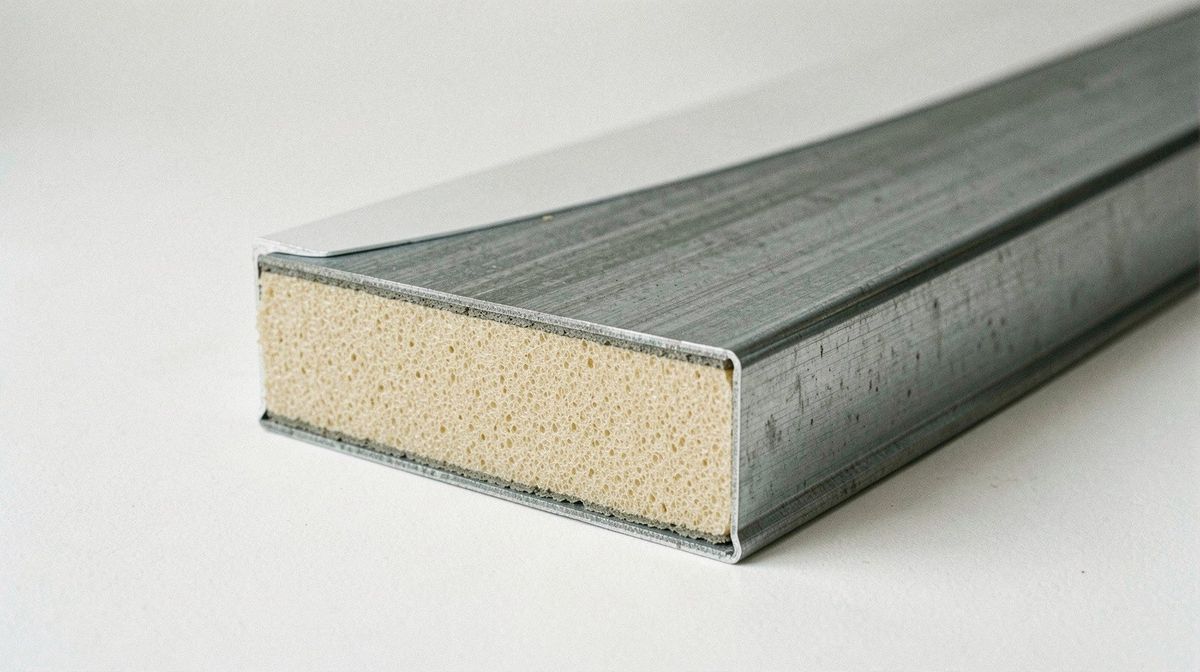
An insulated garage door is built with an insulating core between an exterior and interior surface. DASMA describes a typical insulated door as an exterior surface, an interior surface and an insulating core material, with air films adding a small R-value. The core can be polystyrene or polyurethane foam; DOE’s table gives polystyrene at R-3 to R-5 per inch (EPS and XPS) and polyurethane foam at R-7 to R-9 per inch as materials in general. Door sections vary, so use the door’s own spec.
R-value versus U-factor for doors
U-factor is the tested whole-door rating, and R-value is a calculated figure for a section, so look for U-factor when comparing doors. DASMA says the two are not comparable, that U-factor provides the highest degree of confidence, and that recognized codes use U-factor. Lower U-factor means better insulation. DASMA’s worked example of a section with 1 3/8 inch and 1 7/8 inch polyurethane foam and a k-factor of 0.12 yields a section R of 16.47; that is an illustration of the math, not a spec for any door.
Does it warm the garage?
A better door lowers heat loss through the door, but the garage’s other leaks and your heater decide how warm it gets. No source we opened gives a temperature gain for an insulated door in cold weather, so this page makes no promise. Seals, section joints and thermal breaks matter to the whole assembly, per DASMA. See garage insulation for walls and ceiling.
When a new door beats a kit
A new door often makes sense when the existing door is damaged, worn or hard to balance, but this page quotes no costs. No dated primary price source was opened. Weigh these factors: condition and age of the existing door, how often you heat the garage, installation of springs and hardware by a trained technician, opener compatibility and the tested U-factor. See the garage door guide and how to measure a door, or compare with door insulation kits.
What to check on a spec sheet
- Tested whole-door U-factor, and the test standard (ANSI/DASMA 105, per DASMA).
- Insulation material and thickness, and how any R-value was calculated.
- Seals: bottom, side and top.
- Thermal breaks and section joint design.
- Window or glazing options and their U-factor.
- Compatibility with your opener, including balance requirements.
Related pages
| Factor | Insulated door | Kit on existing door |
|---|---|---|
| Rating to compare | Tested whole-door U-factor | Material R-value per inch |
| Seals and joints | Part of the tested assembly | Existing seals remain |
| Springs and hardware | Replaced with a trained technician | Existing, must be rechecked for balance |
| Cost | No dated source opened; compare quotes | No dated source opened |
Replace when the door is worn or hard to balance or you heat the space often; add a kit when the door is sound and the main need is more insulation.
Frequently asked questions
Do insulated garage doors keep the garage warmer?
They can reduce heat loss through the door, but no source we opened gives a general temperature gain. DASMA says joints, thermal breaks and weather seals affect performance, and the rest of the garage matters too. Seal leaks and insulate walls and ceiling for the best result.
What R-value is good for a garage door?
DASMA says R-value is a section calculation and is not comparable to the tested whole-door U-factor, and that U-factor gives the highest confidence for comparing doors. Look for a tested U-factor, where lower is better, rather than a headline R-value alone.
Is polyurethane better than polystyrene?
By material, DOE's table lists polyurethane foam at R-7 to R-9 per inch and polystyrene at R-3 to R-5, so polyurethane is higher per inch. A door's actual performance depends on thickness, joints and seals, so compare the door's tested U-factor instead of the core type alone.
Do I need an insulated door if the garage is attached?
No source we opened sets such a requirement for homeowners. DOE lists the walls between the living space and the garage, and floors above an unconditioned garage, among the paths where air leaks. Ask your local building department about requirements, and consider the whole garage envelope, not only the door.
Do insulated doors cost more to run an opener on?
No source we opened addresses opener running cost. Heavier doors need correct springs, and DASMA says safe operation depends on a balanced door and working opener and entrapment protection. A new door installed by a trained technician should be balanced for its weight.
Sources and further reading
- DASMA Technical Data Sheet 163: U-factor and R-value for Residential and Commercial Garage Doors (PDF) (dasma.com)
- DASMA Technical Data Sheet 167: Sectional Garage Door and Electric Operator Checklist (PDF) (dasma.com)
- DASMA: Automatic Garage Door Opener Safety and Maintenance Guide (PDF) (dasma.com)
- U.S. DOE Building America: Energy Renovations, Insulation (PDF, 2012) (energy.gov)
- ENERGY STAR: DIY Checks and Inspections (energystar.gov)
Related articles
- Garage Door Insulation: Options, R-Value and Cost
Compare garage door insulation methods, R-value versus U-factor, air sealing and balance safety, with sources from DASMA, DOE and ENERGY STAR.
- Garage Insulation: What to Insulate and Which R-Value
Garage insulation explained: where heat escapes, ENERGY STAR and DOE R-values by climate zone, insulation types compared, and attached-garage safety.
- Garage Ceiling Insulation: Materials and Cold-Climate Tips
How to insulate a garage ceiling in a cold climate: target R-values from ENERGY STAR, air sealing first, light and flue clearances, and when to call a pro.
- Garage Door Insulation Kits: Types and What to Check
What is in a garage door insulation kit, how foam, fiberglass and reflective materials compare by R-value and fire safety, and what to check before buying.
- Garage Insulation Cost: Material and Labor Factors
What decides garage insulation cost: area, R-value, material and access. Includes a fill-in worksheet, since we print no prices without a dated source.
- How to Insulate a Garage: Walls, Ceiling and Door
Step-by-step order of work to insulate a garage: seal air leaks, then walls, ceiling and door, with safety, fire-barrier and heater-clearance notes.