How to Epoxy a Garage Floor, Step by Step
Posted by MN Garage Notes Editorial Team Reviewer: MN Garage Notes Editorial Team Most recently reviewed Published In Garage floors
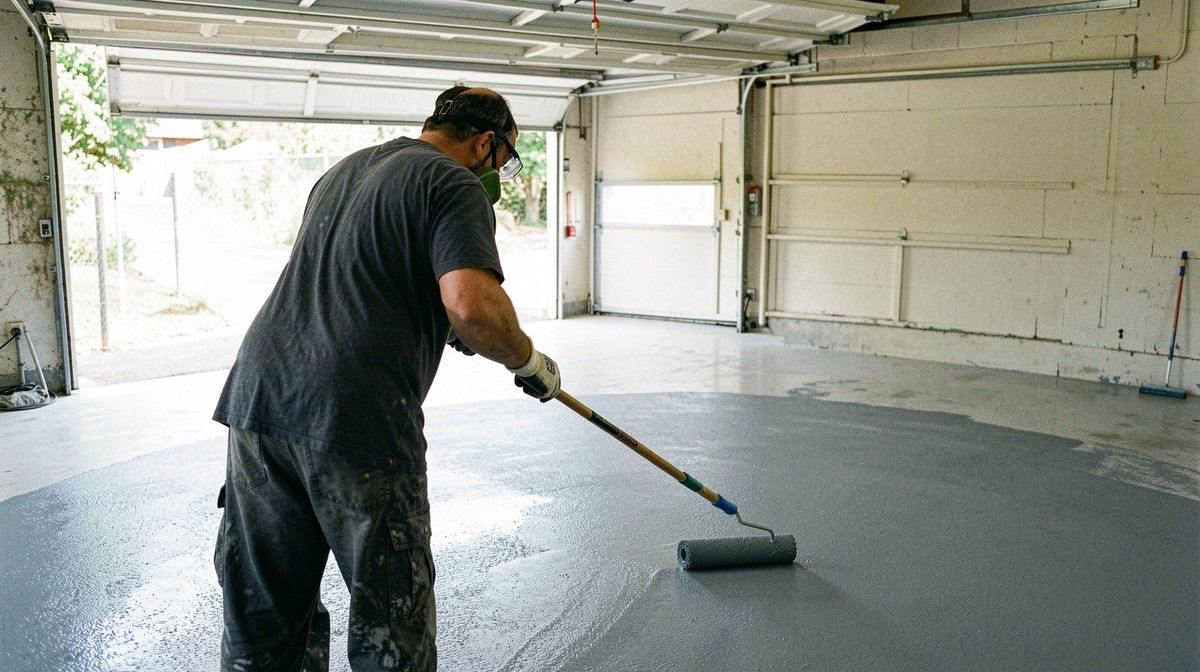
To epoxy a garage floor, read the safety data sheet and data sheet first, check air and slab conditions, test the concrete for moisture, clean, degrease and profile it, repair cracks, then mix, roll and cure each coat exactly as the product says. Ventilate, wear gloves and eye protection, and use no open flame or fuel-burning heater unless the label allows it.
Belongs to the guide: Garage Flooring Options: Coatings, Tiles and Mats
Safety note. Background reading only. Treat it as no stand-in for your owner’s manual, the maker’s install sheet, your local building and fire code, or a licensed tradesperson. A garage can hold carbon monoxide, open flame, live circuits, wound springs and solvent fumes. The Garage Notes team checked each claim against the sources listed on this page; it holds no trade licence.
This is a general sequence to read alongside your product’s data sheet, not a replacement for it. It supports the floor choice guide; for what epoxy is, see epoxy as a floor option, and read the epoxy safety basics page first.
Safety first: ventilation, PPE and the SDS
Read the safety data sheet and label before opening anything. OSHA requires data sheets in a specified 16-section format and labels with a signal word, pictogram and hazard statement.
- Uncured epoxy can be a significant skin hazard, and sensitization can develop. Wear chemical-resistant gloves, long sleeves and eye protection.
- Some amine hardeners can irritate the nose, throat and lungs. Choose respiratory protection from the SDS; see OSHA’s respiratory protection page.
- Ventilate. EPA advises increasing ventilation when using products that emit VOCs.
- No open flame, pilot lights or sparks. Do not run a fuel-burning heater to speed cure unless the label allows it.
- Keep children, pets and anyone with asthma out.
Check conditions: temperature, humidity and moisture
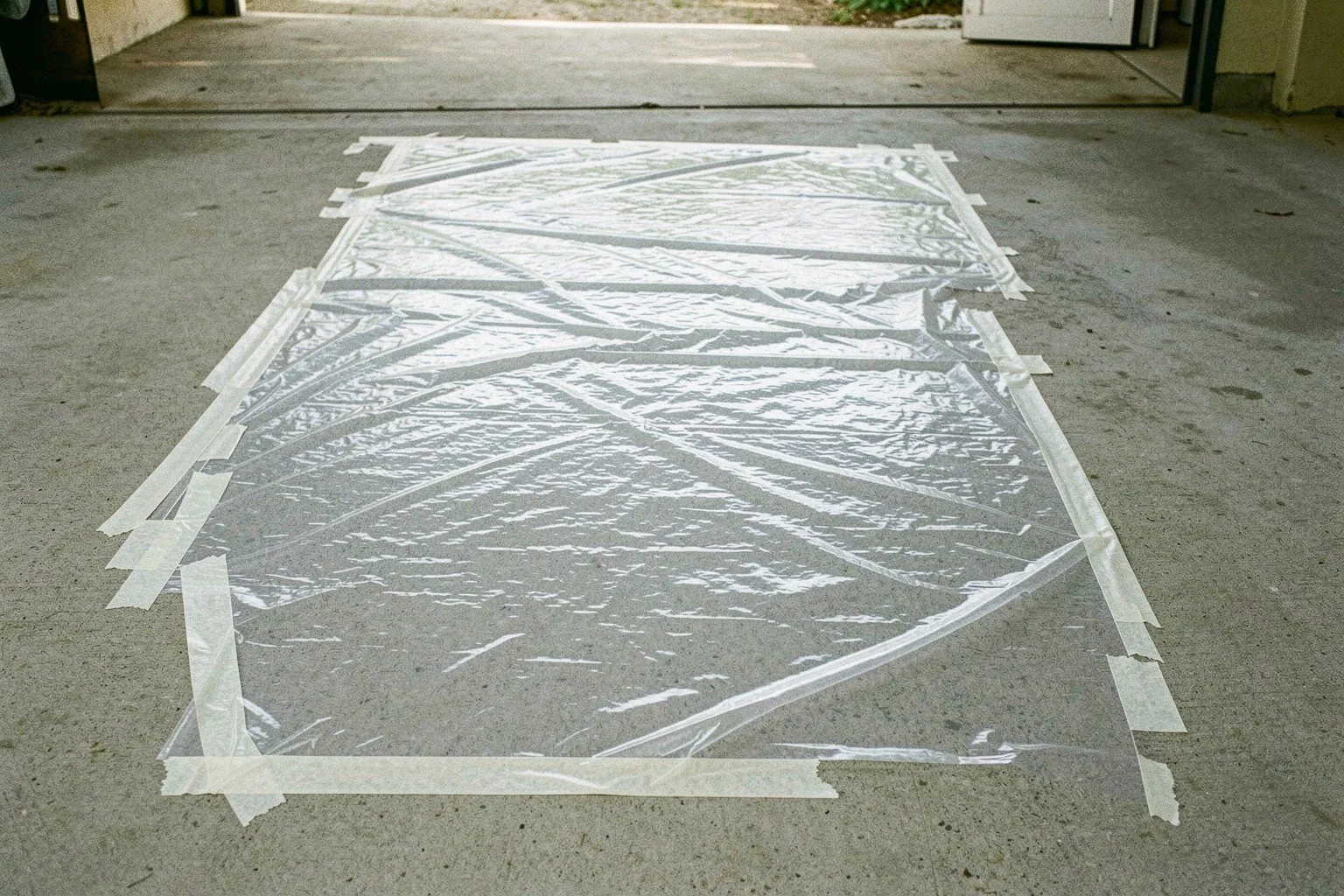
Check the data sheet for allowed air temperature, slab temperature and humidity, and do not work outside them. Then run the moisture test: the plastic sheet method, ASTM D4263, is used to indicate capillary moisture in concrete before coating. If moisture shows, stop and address it before coating.
Clear, degrease, and profile the concrete
- Empty the garage and cover or move anything you cannot remove.
- Remove oil and grease with the degreaser the data sheet allows; rinse and dry fully.
- Profile the surface (grinding or etching) as the data sheet requires. Control dust.
- Vacuum thoroughly.
Repair cracks and pits
Fill cracks and pits with the repair product the data sheet names, and let it cure. Large or moving cracks may point to a structural issue; consult a concrete contractor.
Mix, roll, flake and topcoat
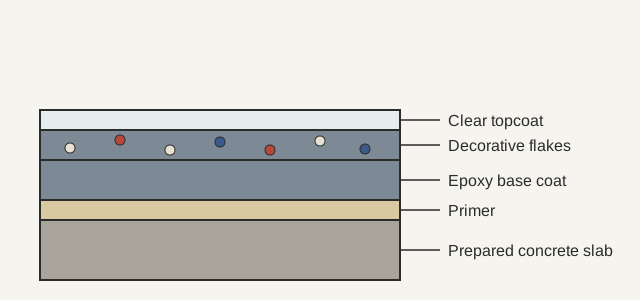
Follow the data sheet for mixing ratio, pot life, spreading rate and recoat window. Mix only what you can use before it begins to set. In order: primer if required, base coat, flakes if used, then topcoat.
Cure, recoat and return to service
Cure, recoat and return-to-service times come from the data sheet for your conditions, not from a general rule. Keep the floor dry and clear until the maker says it is ready.
Common mistakes
- Skipping the moisture test.
- Mixing more than you can place within the pot life.
- Applying too thin or too thick.
- Working outside the temperature and humidity limits.
- Parking before the maker’s return-to-service time.
Cleaning up and disposal
Keep leftovers in original containers and never mix them. EPA says not to pour household chemicals down a drain, and to use local hazardous waste programs. Follow the data sheet and SDS for cured and uncured waste.
Cleaning and care
Rinse winter salt off regularly and sweep. See floor coatings for what to expect. Estimate material with the coverage calculator. If you keep a heater in the garage, read the garage heater guide.
Related guides
Frequently asked questions
How long does it take to epoxy a garage floor?
The answer depends on prep and the product. Prep, coats and cure are separate stages with their own times on the data sheet, so add them up for your product, plan a warm, dry window and do not park until the maker says so. Do not rush a coat: recoat windows matter.
Do I need to grind the concrete?
Many data sheets call for profiling the slab by grinding or etching. Your product's data sheet states what it requires, and grinding makes dust, so follow the data sheet and SDS on dust control and respiratory protection. If the data sheet is silent, ask the maker before coating.
How do I test for moisture before epoxy?
The plastic sheet method, ASTM D4263, indicates capillary moisture in concrete before coating. Details such as sheet size and time are in the standard and your data sheet. It is a basic indicator only; if the maker requires a quantitative test, follow that instead. If moisture shows, do not coat.
Can I epoxy a garage floor in the winter?
Only if both the air and slab temperatures, and the humidity, are inside the data sheet's limits. A cold slab can slow cure or cause condensation. Do not use a fuel-burning heater to warm the space unless the label allows it. Wait for a suitable window if conditions fall outside the limits.
Can I epoxy over old paint?
Often not directly. Old paint or sealer may need removal or profiling so the new coating can bond, and some products specify what they can go over. Check the data sheet, test a small patch, and ask the maker. Loose or peeling paint must be removed.
Sources and further reading
- OSHA Technical Manual, Section III Chapter 1: epoxy resins and amine hardeners (osha.gov)
- EPA: Volatile Organic Compounds' Impact on Indoor Air Quality (epa.gov)
- EPA: Household Hazardous Waste (epa.gov)
- OSHA: Hazard Communication (labels and safety data sheets) (osha.gov)
- OSHA: Respiratory Protection (osha.gov)
- ASTM D4263: Indicating Moisture in Concrete by the Plastic Sheet Method (public abstract) (store.astm.org)
Related articles
- Garage Flooring Options: Coatings, Tiles and Mats
Compare garage flooring options for cold climates: coatings, tiles, mats and sealers, what concrete prep each needs, and the ventilation and safety basics.
- Epoxy Garage Floors: How They Work, Cost and Limits
How an epoxy garage floor coating system works, what prep matters, cost drivers, cold-climate limits, and the safety rules to read before you start.
- Epoxy Garage Floor Kits: What Is in the Box and What to Check
What comes in an epoxy garage floor kit, how coverage claims work, kit types, and the data sheet and safety checks to make before you buy. No brand picks.
- Epoxy Garage Floor Safety: Fumes, Ventilation and PPE
Safety rules for epoxy garage floor work: the SDS, skin and eye protection, fumes and ventilation, ignition sources, disposal and attached-garage cautions.
- Garage Floor Coatings: Epoxy, Polyaspartic and Paint
Compare garage floor coating types: epoxy, polyaspartic, polyurea and paint. What differs, what prep they share, and how to check moisture first.
- Garage Floor Paint: Is It Worth It, and How to Apply
When garage floor paint makes sense compared with epoxy, what types exist, how prep and moisture decide results, and the ventilation and safety basics.