Common Garage Door Problems and Safe Fixes
Posted by MN Garage Notes Editorial Team Reviewer: MN Garage Notes Editorial Team Most recently reviewed Published In Garage doors
Most garage door problems fall into four groups: the door is stuck, off track, out of balance, or noisy. You can safely check the opener, clear the tracks, look at hardware and test balance by hand. Do not touch springs, cables or bottom brackets; DASMA says only trained technicians should work on them. A door that is heavy or crooked needs a professional.
Belongs to the guide: Garage Doors: Types, Materials, Sizes and Openers
Safety note. Background reading only. Treat it as no stand-in for your owner’s manual, the maker’s install sheet, your local building and fire code, or a licensed tradesperson. A garage can hold carbon monoxide, open flame, live circuits, wound springs and solvent fumes. The Garage Notes team checked each claim against the sources listed on this page; it holds no trade licence.
Garage doors are heavy and held up by high-tension hardware, so the right first move is often to look, not to touch. This is the triage page in our garage doors guide: what you can check, what to leave alone, and what to ask a technician. Springs have their own page: garage door springs.
Safety rules before you touch anything
Keep people, children and pets clear of the door. Use handles or gripping points, and never place fingers between sections, as DASMA warns. Do not loosen anything on the springs, cables or bottom brackets, and do not remove or bypass photo eyes or auto-reverse. If the door is not safely supported, do not walk or park under it.
First look: balanced, off track or just stuck?
Run the simple hand test described by CPSC. Close the door, pull the opener’s quick-release to disconnect it, then move the door up and down using the handle. Skip this test and call a technician if a spring has a gap or a cable is frayed or loose.
- Moves smoothly and stays partway open: balanced; the problem is probably the opener, sensors or a limit setting. See opener fixes you can try first.
- Heavy, rises or drops on its own: out of balance; spring problem. Stop.
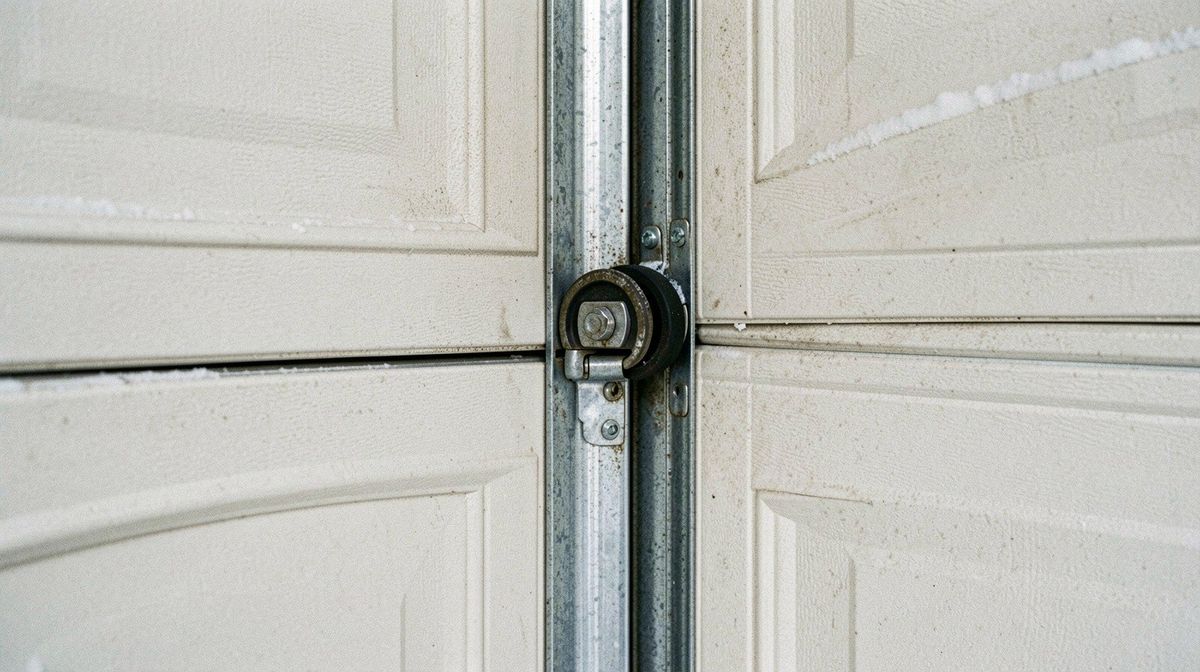
- Sticks, scrapes or will not stay in the track: track, roller or hardware problem; look but do not force.
Door will not open or close: checklist
- Power to the opener and wall button; remote battery.
- Door lock or vacation mode on the wall control.
- Photo eyes clean and aligned (no higher than 6 inches above the floor, per DASMA).
- Obstruction, ice or snow on the threshold or track.
- Door disconnected or reconnected at the trolley.
- Broken spring or cable: if the door is heavy or a cable hangs loose, stop.
Noisy, jerky or shaking doors
Noise is often normal wear. Dry rollers and hinges, loose hardware and a dry spring are common causes. DASMA says springs can squeak from normal use and suggests a spray-on lubricant made for garage doors first; call a professional installer if the noise continues. Do not tighten brackets or spring parts.
Off track or a dented panel
A door off its track or with a bent panel is a safety risk. Stop using the opener, keep the door closed if it is stable, and call a trained technician. Do not hammer the track or try to lift the door back on.
Broken cable or spring: stop, do not touch
Broken springs and frayed or snapped cables are stop-and-hire problems. DASMA says springs wear out and can cause injury when they break, that cables and bottom brackets are under high tension, that cables should be replaced only by a trained technician, and that bottom brackets should be adjusted only by one. If the door has two springs, DASMA advises replacing both even if one is not broken. See torsion and extension springs for symptoms and what to ask a technician.
Cold-climate problems
- Frozen bottom seal: clear snow and ice from the sill; do not force a frozen door open with the opener.
- Stiff weatherstripping: check that it is not stuck or torn before the door closes.
- Frost heave at the threshold: uneven concrete can stop the door seating or block the seal; a technician or concrete contractor can advise.
- Heavy, stiff door: may trip the opener; the cause may be a spring, not the cold.
If drafts are the main concern, see insulate a garage door.
Fix-it list: what homeowners can do
- Monthly visual check of the door, cables and hardware (CPSC advises every 30 days).
- Clean photo eyes and clear the sill.
- Lubricate according to the door maker’s instructions.
- Run the 2x4 reversal test: if the door does not reverse when it strikes the board, disengage the opener until it is adjusted per the manual, repaired or replaced.
- Check weatherstripping for tears.
Stop list: when a trained technician is the right call
Stop and call a trained garage door technician for any of the following.
- Broken spring, loose cable, or gap in a torsion spring.
- A door that is heavy, falls, or will not stay partly open.
- A door off track or with a bent panel.
- An opener that will not reverse.
- Any adjustment to springs, cables or bottom brackets.
When you call, say what you saw and what you did. Ask the technician to explain the problem, describe which parts will be replaced, confirm whether both springs will be replaced, and state the warranty in writing.
Related guides
Frequently asked questions
Why won't my garage door close all the way?
Common causes are an obstruction or ice at the threshold, misaligned photo eyes, or a travel limit that needs setting. Clear the sill, clean and aim the eyes per the manual, and test again. If the opener keeps reversing, follow our opener troubleshooting page. Never disable the sensors to make the door close.
Why is my garage door so loud?
Noise usually comes from dry or worn rollers and hinges, loose hardware, or a dry spring. DASMA says springs can squeak from normal use and suggests a spray-on lubricant made for garage doors first; if it continues, call a professional installer. Do not tighten or adjust spring or bracket hardware yourself. Loose track bolts can be reported to a technician.
Why is my garage door crooked or off track?
A door that sits crooked, gaps at one side or has a bent track is usually off track or has a spring or cable problem. Stop using the opener. Do not force the door or try to bend the track back. Have a trained technician inspect it, since the repair may involve tension hardware.
Can I fix a garage door spring myself?
No. DASMA states that spring systems are dangerous and should be repaired only by trained professionals, and that cables and bottom brackets are under high tension. We give no replacement steps. Identify the symptom, keep people clear, leave the door as it is, and hire a trained technician.
How do I know if my garage door is balanced?
CPSC's check is done with the door closed: pull the opener's quick-release, then move the door up and down by its handle. A balanced door moves smoothly and stays in place when stopped partway. Skip the check if a spring has a gap or a cable is frayed or loose. If the door rises or falls on its own or is very heavy, it needs a professional. Never try to adjust the springs.
Is it safe to open a garage door by hand if the spring is broken?
Usually not. A door with a broken spring can be very heavy and may fall, and a damaged cable can add risk. Keep people and vehicles clear, do not lift it, and call a trained technician. If the door is closed, leave it closed until it is repaired.
Sources and further reading
- CPSC: Non-Reversing Automatic Garage Door Openers Are a Hazard (Pub. 523) (cpsc.gov)
- DASMA: Garage Door Safety Tips (dasma.com)
- DASMA: Garage Door Systems Safety Tips (dasma.com)
- DASMA: Garage Door Opener Safety Tips (dasma.com)
- 16 CFR Part 1211: Safety Standard for Automatic Residential Garage Door Operators (Cornell LII) (law.cornell.edu)
- DASMA: Technical Data Sheets index (dasma.com)
Related articles
- Garage Doors: Types, Materials, Sizes and Openers
Plain-English guide to garage doors: door types, materials, standard sizes, openers, what to inspect, and which spring and cable jobs need a technician.
- Garage Door Remotes: Types, Compatibility and Programming
How garage door opener remotes work, how to tell which remote fits your opener, how to program one from the owner's manual, and what to do when it stops.
- Garage Door Opener Not Working: Troubleshooting
Step-by-step checks when a garage door opener will not work: power, wall button, remote, manual release and safety sensors, plus when to call a technician.
- Standard Garage Door Sizes and Measuring
Standard single and double garage door widths and heights, how to measure width, height, headroom and side room, and when you need a custom size.
- Garage Door Springs: Torsion vs Extension and Safety
What garage door torsion and extension springs do, how to spot a worn or broken one, and why spring and cable work is for a trained technician only.