Garage Heaters: Types, Sizing and Safety
Posted by MN Garage Notes Editorial Team Reviewer: MN Garage Notes Editorial Team Most recently reviewed Published In Garage heating
A garage heater is best chosen by type, not brand: electric heaters avoid combustion gases but need a suitable circuit, while natural gas and propane heaters need venting, carbon monoxide controls and usually a licensed installer. Insulate and seal first, size the heat load, keep 3 feet of clearance, and follow the manual and local code.
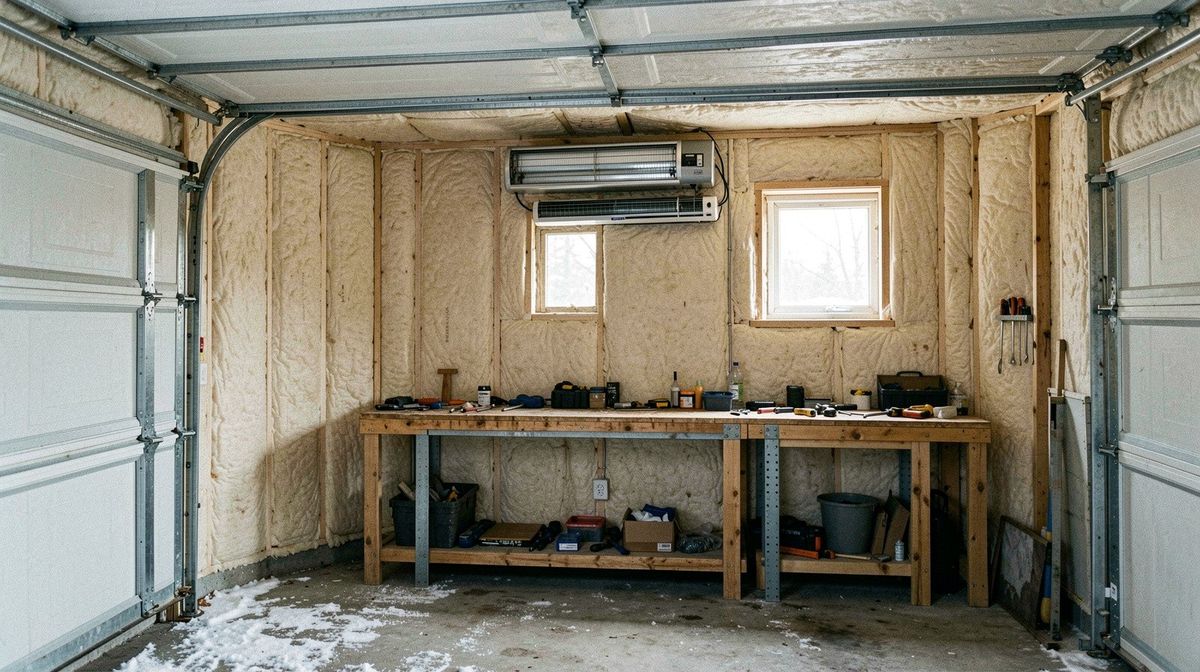
Choosing a heater starts here: this guide compares the main heater types and safety rules, then points to the type-specific pages linked below.
Background reading only. Treat it as no stand-in for your owner’s manual, the maker’s install sheet, your local building and fire code, or a licensed tradesperson. A garage can hold carbon monoxide, open flame, live circuits, wound springs and solvent fumes. The Garage Notes team checked each claim against the sources listed on this page; it holds no trade licence.
Read this first: carbon monoxide, fire and flammable vapors
Three hazards decide which heater can go in a garage: carbon monoxide, fire and ignition of flammable vapors. The CDC describes carbon monoxide (CO) as an odorless, colorless gas that kills without warning, and the CPSC calls it the “Invisible Killer.” Fuel-burning heaters can make it, so the owner’s manual, local code and a licensed professional decide what is allowed in your garage. Consult your owner’s manual before you buy, install or run any heater.
- Electric heaters make no combustion gases, but they can still start fires. NFPA says to keep anything that can burn at least 3 feet from heating equipment, and the electric heater maker’s manual we opened repeats the 3-foot figure for the front of the heater.
- NFPA says all fuel-burning equipment should be vented to the outside to avoid CO poisoning. This site never suggests running an unvented fuel-burning heater in a closed garage, and never suggests bypassing a safety device.
- Heaters have hot and sometimes sparking parts. One electric heater manual we opened says not to use the heater where gasoline, paint or flammable liquids are used or stored. Garages usually hold exactly those, so read the full garage heater safety page.
- Install CO alarms and test them. Stop and call a professional for gas lines, venting, new circuits or anything you cannot verify in the manual.
The heater types compared
Garage heaters fall into a few families: electric forced-air or radiant, natural gas unit heaters, and propane units. Each family has a different hazard and a different installer requirement. The table compares them by what a homeowner must check, not by brand.
| Type | Fuel | Vent to outside needed? | Main hazard to manage | Who installs it |
|---|---|---|---|---|
| Electric forced-air (plug-in or hardwired) | Electricity | No combustion vent | Fire from clearances, cords and flammable vapors; circuit capacity | Plug-in: you, per manual. Hardwired 240 V: a licensed electrician in most cases |
| Electric infrared / radiant | Electricity | No combustion vent | Fire from hot surfaces near combustibles | Per manual; hardwired units follow the electric rules |
| Natural gas unit heater | Natural gas | Yes, for the vented types (see the manual) | CO, gas leaks, ignition of vapors near the floor | Licensed gas fitter, with permit where required |
| Propane (LP) heater | Propane | Depends on the unit; unvented portables are a major CO source | CO, cylinder handling, leaks | Fixed units: licensed professional. Portables: manual and CPSC guidance |
| Kerosene and other liquid-fuel heaters | Liquid fuel | Per manual | CPSC’s 2021 CO deaths report names kerosene among CO-producing fuels | Per manual; this site does not cover them in depth |
Pages on each type: 120V and 240V electric options, propane heater venting and CO, vented gas unit heaters and infrared and radiant garage heaters. For the order of work, see the order of work for heating.
How much heat a garage needs
The heat a garage needs depends on how much it leaks, how large it is and how warm you want it, and insulation changes that more than the heater does. The Department of Energy says up to 25 percent of a home’s heat is lost through small cracks and holes, and its home heating guide says proper sizing is as important as efficiency: an oversized system costs more to operate. That guide is written for house heating, so treat it as a principle, not a garage rule.
Practical order of work:
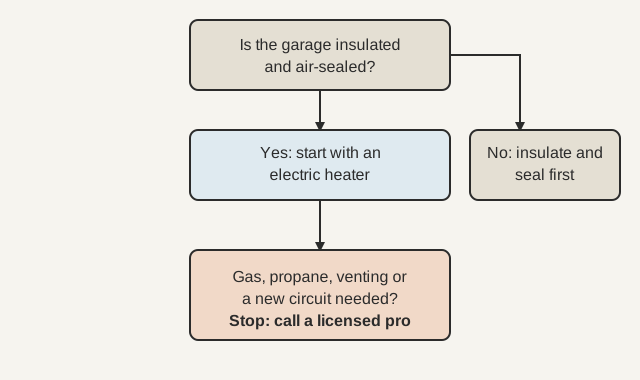
- Seal air leaks and insulate first. See sealing and insulating the garage and insulating the door, and the cold-climate ceiling insulation notes.
- Calculate the heat load with the garage heater size calculator. This page does not publish a one-size BTU number because the answer depends on your insulation, climate and target temperature.
- Convert watts to BTU when comparing electric heaters. One manufacturer’s table lists a 5,000 W heater at 17,065 BTU per hour, which is about 3.41 BTU per hour per watt.
Electric versus fuel-burning
Electric heaters avoid combustion gases but need electrical capacity; fuel-burning heaters can deliver more heat per unit but add CO, venting and gas-code requirements. An electric 240 V garage heater needs its own circuit sized to its nameplate. One manufacturer’s data sheet pairs a 5,000 W, 240 V model with 10-gauge wire and a 30 amp two-pole breaker, and a 2,850 W model with 14-gauge wire and a 15 amp breaker. Those figures are examples from one data sheet, not a recommendation for your panel; the heater’s nameplate, the manual and your local electrical code decide.
For fuel-burning heaters, the CPSC’s 2021 data attributes 25 estimated consumer-product CO deaths to LP gas heating systems, and about 78 percent of those involved unvented portable propane heaters meant for camping or temporary spaces. See propane units and gas unit heaters.
Safety first: clearances, ignition sources and alarms
Keep 3 feet of clear space around heaters, keep flammable liquids away, and put working CO alarms in place before the first cold night. NFPA, USFA and the CPSC all give the 3-foot clearance for portable heaters. Manuals set the exact distances for each model; one electric unit heater manual we opened requires a 36-inch discharge clearance and a minimum mounting height of 6 feet.
- Turn portable heaters off when you leave or go to bed (NFPA, USFA, CPSC).
- Plug portable electric heaters directly into a wall outlet, not an extension cord or power strip (NFPA, CPSC).
- Refuel fuel-burning portable heaters only after they have cooled (CPSC).
- CO alarms: the CPSC advises alarms on every level and outside sleeping areas. Minnesota Statute 299F.51 requires an alarm within 10 feet of each room used for sleeping in a single-family home. That statute line concerns bedrooms, so check your heater manual for garage alarm advice.
Full detail: garage heater safety.
Installation basics and when a licensed trade is required
Gas, propane piping, venting and new 240 V circuits are licensed-trade and permit work; this site explains them but gives no wiring or gas-line steps. NFPA says to have a qualified professional install stationary space heating equipment according to local codes and the manufacturer’s instructions. One gas unit heater manual we opened states that installation and service must be done by a licensed professional installer, service agency or the gas supplier, and calls for combustion air and venting to the national fuel gas code and local codes. Ask your local building department whether a permit is required.
Running cost factors
Running cost is energy used times your rate, so the formula matters more than a quoted price. For electric heaters: kilowatts times hours of use times your price per kilowatt-hour. For fuel-burning heaters: fuel consumed per hour times price per unit of fuel, adjusted for the unit’s efficiency from its manual. This page quotes no dollar figures because no dated primary price source was opened. Insulation, thermostat settings and how long you hold the temperature usually move the total more than the heater type.
Which heater for which garage
| Your situation | What to look at first | Page |
|---|---|---|
| Insulated, occasional use, existing outlet | Electric, per the manual’s circuit and clearance rules | Plug-in and hardwired electric units |
| Large or leaky space, existing gas service | Vented natural gas unit heater installed by a licensed pro | Natural gas garage heaters |
| No gas line, want fuel-burning heat | Propane: check venting and the manual before anything else | Propane garage heaters |
| Drafty, high ceiling, spot work | Radiant or infrared, mounted per the manual | Radiant infrared heat |
| Not sure where to start | Process: insulate, size, then choose | heating a garage step by step |
Which type is “best” depends on your insulation, fuel access, local code and the unit’s manual. This site does not rank brands.
Maintenance and annual checks
Have fuel-burning heating equipment cleaned and inspected every year by a qualified professional. NFPA and USFA both say so, and the CDC says to have gas, oil or coal burning appliances serviced by a qualified technician every year. Test CO alarms monthly and replace batteries at least once a year, or use sealed 10-year units, as the CPSC advises. For electric heaters, inspect the cord and plug for damage and keep the intake and outlet clear; one manual we opened says not to block the air intake or exhaust.
Related pages
| Type | Fuel | Vent to outside? | Main hazard | Who installs it |
|---|---|---|---|---|
| Electric forced-air | Electricity | No combustion vent | Fire, circuit load | Plug-in: you per manual; 240 V hardwired: licensed electrician in most cases |
| Electric infrared/radiant | Electricity | No combustion vent | Hot surfaces near combustibles | Per manual |
| Natural gas unit heater | Natural gas | Yes for vented types | CO, gas leaks | Licensed gas fitter |
| Propane | Propane | Depends on unit | CO, cylinders, leaks | Fixed: licensed pro; portable: manual and CPSC guidance |
Pick the family that matches your fuel access and insulation, then read that type's page and the manual. Anything involving gas, venting or a new circuit is licensed-trade work.
All Heating guides
- Electric Garage Heaters: 120V vs 240V, Wattage, Circuit
How electric garage heaters work, how to convert watts to BTU, what 120V and 240V mean for circuits, and the clearance and cord rules from NFPA.
- Garage Heater Safety: CO, Clearances and Fire Risk
Garage heater safety explained from CPSC, CDC, NFPA and USFA sources: carbon monoxide, clearances, flammable vapors, alarms and what never to do.
- How to Heat a Garage: Options, Sizing and Cost Factors
How to heat a garage in order: insulate and seal, find the heat load, pick a heater type, and follow the carbon monoxide and clearance rules.
- Infrared and Radiant Garage Heaters Explained
Infrared and radiant garage heaters explained: electric versus gas-fired types, 3-foot clearances, manual mounting rules and fire safety near vapors.
- Natural Gas Garage Heaters: Vented Unit Heaters Explained
Vented natural gas unit heaters in a garage: venting, combustion air, one manual's 18-inch burner height and why a licensed pro must install.
- Propane Garage Heaters: Safety, Venting and Sizing
Propane garage heater safety, venting and sizing basics from CPSC, NFPA and DOE: vented versus unvented units, CO risk, cylinders and who should install.
Frequently asked questions
What is the best way to heat a garage?
The best way depends on insulation, fuel access and local code, so there is no single answer. Insulate and air-seal first, size the heat load with a calculator, then match a heater family to your fuel and use pattern. Electric heaters avoid combustion gases; gas and propane heaters need venting and a licensed installer. Always follow the owner's manual.
Is it safe to use a heater in an attached garage?
Safety depends on the heater type and installation, and this site cannot declare any setup safe. The CDC says never to run a car in an attached garage even with the door open, and NFPA says fuel-burning equipment should be vented outside. Follow the manual, keep 3 feet of clearance, keep flammable liquids away and use working CO alarms.
How many BTUs do I need to heat my garage?
The number depends on garage size, insulation, air leaks, climate and your target temperature, so this page does not publish one. Use the garage heater size calculator for your inputs. When comparing electric heaters, one manufacturer's table lists 5,000 W as 17,065 BTU per hour, about 3.41 BTU per hour per watt.
Can I use a kerosene or unvented propane heater in a garage?
Only if the heater's own manual explicitly allows it, and even then the risks are serious. DOE says unvented combustion heaters can cause carbon monoxide poisoning and should carry an ANSI Z21.11.2 label. CPSC data links unvented portable propane heaters to most LP gas heating deaths in 2021. When in doubt, choose a vented or electric heater.
Is an electric heater cheaper than gas?
It depends on local electricity and gas prices, which this page does not quote because no dated primary price source was opened. Compare using formulas: electric cost is kilowatts times hours times your rate per kilowatt-hour; gas cost is fuel use per hour times your fuel price, adjusted for the unit's efficiency from its manual.
Do I need a permit to install a garage heater?
Often yes for gas piping, venting or new hardwired circuits, but rules vary by city and county. NFPA advises having a qualified professional install stationary heating equipment per local codes and manufacturer instructions. Ask your local building department before you start, and expect a licensed gas fitter or electrician to do the work.
Sources and further reading
- CPSC: Carbon Monoxide Information Center (cpsc.gov)
- CDC: About Carbon Monoxide Poisoning (cdc.gov)
- NFPA: Heating Safety tip sheet (PDF) (nfpa.org)
- NFPA: Electric Portable Space Heater Safety tip sheet (PDF) (content.nfpa.org)
- USFA: Heating Fire Safety (usfa.fema.gov)
- U.S. Department of Energy: Home Heating guide (PDF) (energy.gov)
- CPSC: Keep Warm and Safe This Winter (2026 release) (cpsc.gov)
- CPSC: Non-Fire Carbon Monoxide Deaths Associated with the Use of Consumer Products, 2021 Annual Estimates (PDF) (cpsc.gov)
- Minnesota Statutes 299F.51: Requirements for carbon monoxide alarms (revisor.mn.gov)
- Example manufacturer manual: separated-combustion unit heater installation instructions, 508065-01 (PDF) (lennox.com)
- Example manufacturer manual: FUH Series electric unit heater installation, operation and maintenance instructions (PDF) (marleymep.com)
- Example manufacturer data sheet: EKB Series garage/shop electric heater (PDF) (king-electric.com)
Related articles
- Electric Garage Heaters: 120V vs 240V, Wattage, Circuit
How electric garage heaters work, how to convert watts to BTU, what 120V and 240V mean for circuits, and the clearance and cord rules from NFPA.
- Garage Heater Safety: CO, Clearances and Fire Risk
Garage heater safety explained from CPSC, CDC, NFPA and USFA sources: carbon monoxide, clearances, flammable vapors, alarms and what never to do.
- Natural Gas Garage Heaters: Vented Unit Heaters Explained
Vented natural gas unit heaters in a garage: venting, combustion air, one manual's 18-inch burner height and why a licensed pro must install.
- How to Heat a Garage: Options, Sizing and Cost Factors
How to heat a garage in order: insulate and seal, find the heat load, pick a heater type, and follow the carbon monoxide and clearance rules.
- Infrared and Radiant Garage Heaters Explained
Infrared and radiant garage heaters explained: electric versus gas-fired types, 3-foot clearances, manual mounting rules and fire safety near vapors.
- Propane Garage Heaters: Safety, Venting and Sizing
Propane garage heater safety, venting and sizing basics from CPSC, NFPA and DOE: vented versus unvented units, CO risk, cylinders and who should install.