Infrared and Radiant Garage Heaters Explained
Posted by MN Garage Notes Editorial Team Reviewer: MN Garage Notes Editorial Team Most recently reviewed Published In Garage heating
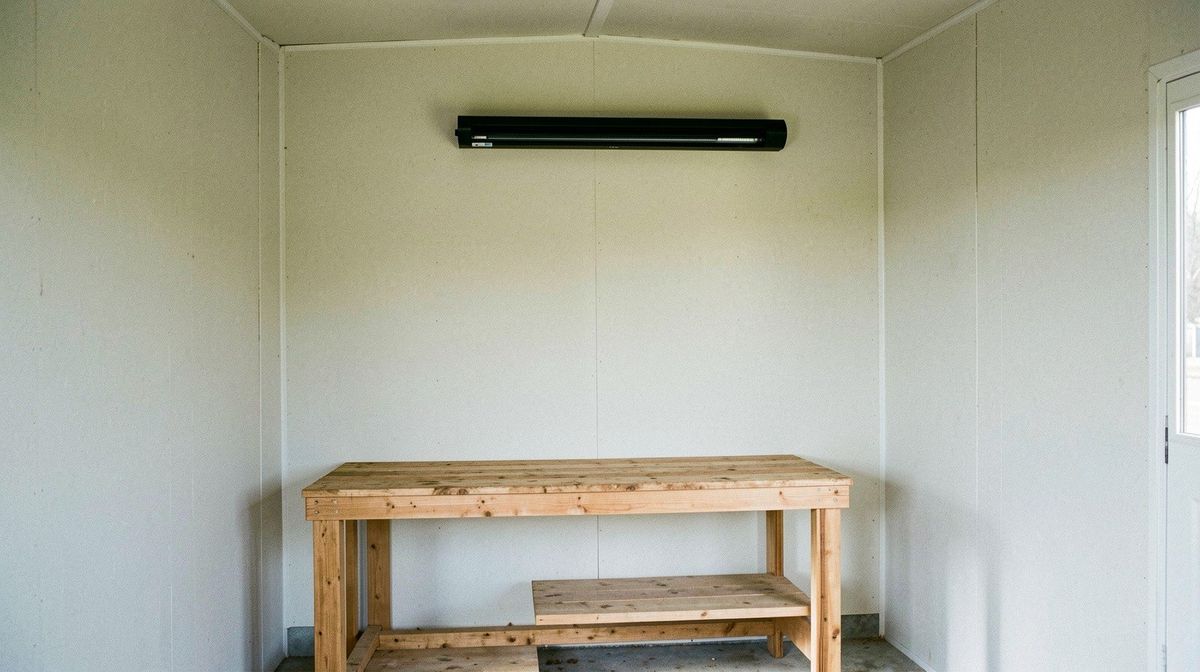
Infrared and radiant garage heaters come in electric and gas-fired types, and both have hot surfaces that need clearance from anything combustible. NFPA says to keep any space heater at least 3 feet from burnables. Gas-fired radiant units add carbon monoxide and venting rules. Mounting height and distances come from the manual, not a general rule.
Belongs to the guide: Garage Heaters: Types, Sizing and Safety
Radiant units are one family in our heating options compared; this page covers what manufacturers’ manuals and safety tip sheets say about them.
Background reading only. Treat it as no stand-in for your owner’s manual, the maker’s install sheet, your local building and fire code, or a licensed tradesperson. A garage can hold carbon monoxide, open flame, live circuits, wound springs and solvent fumes. The Garage Notes team checked each claim against the sources listed on this page; it holds no trade licence.
Safety block: hot surfaces, flammable vapors and your manual
Infrared and radiant heaters have hot surfaces, so clearances to combustibles and flammable vapors matter even more than with some other types. Consult your owner’s manual before choosing a mounting spot. NFPA lists infrared heaters among electric space heater types (heat is created by infrared bulbs) and says to keep any space heater at least 3 feet from anything that can burn, including people. Gas-fired radiant units burn fuel and bring carbon monoxide and venting rules; see vented gas unit heaters and garage heater safety.
How radiant heat works
Radiant heaters warm people and objects directly, and manufacturers describe them as heating a space differently from forced air. This site does not publish performance claims, because no source opened for this page quantifies them. Treat statements such as “warms you, not the air” as marketing until a manual or lab data backs a specific model. What the sources do establish is the safety side: hot surfaces, clearances and fuel rules.
Tube, panel and quartz types; electric versus gas-fired
Radiant garage heaters come as electric infrared units and as gas-fired tube or ceramic units, and the fuel decides the hazards. Electric infrared units follow the rules on 120V and 240V electric options: wall outlet or hardwired circuit, 3-foot clearance, no extension cords. Gas-fired radiant units follow the venting, combustion air and licensed-installer rules in the fuel gas code; see the gas and propane pages. The NFPA heater checklist applies to the electric kind: a qualified testing laboratory seal, thermostat and overheat protection, solid flat surface or secure mounting, and tip-over shut-off for portable units.
Where radiant heaters are commonly used
Radiant heaters are marketed for high-ceiling, drafty or spot-work areas; confirm suitability in the manual. This claim reflects how manufacturers position the products and is not a performance finding. If a garage is leaky, insulation and air sealing change the result more than the heater type; DOE says up to 25 percent of a home’s heat is lost through small cracks and holes.
Mounting height and clearances
Mounting height and clearances come from your manual; this page cannot supply a universal figure. Two examples from garage-heater manuals: one electric unit heater manual we opened requires a minimum mounting height of 6 feet and 36 inches discharge clearance to any object; one garage heater data sheet says wall or ceiling mounting at least 6 feet above the floor, 6 inches to the side, 5 inches from the back, 2 inches from the ceiling and at least 3 feet in front. Those are for forced-air electric units and differ from radiant models, so use your model’s table.
Running cost and warm-up
Cost per hour equals the heater’s kilowatts times your rate, or fuel use per hour times fuel price. Each watt of electric heat is about 3.41 BTU per hour (one manufacturer’s table lists 5,000 W as 17,065 BTU per hour). Warm-up time and comfort claims vary by model and are not quantified on this page. For sizing, use the heat-load calculator.
Pros and cons versus forced air
| Factor | Radiant (electric infrared) | Forced-air electric |
|---|---|---|
| Combustion gases | None | None |
| Hot surfaces | Yes, keep 3 feet clear (NFPA) | Yes, keep 3 feet clear (NFPA, manuals) |
| Moves air | Not by itself | Yes, fan moves air; manual sets clearances |
| Installation | Per manual; hardwired units follow electrical code | Per manual; hardwired units follow electrical code |
| Evidence on comfort and savings | Not quantified here | Not quantified here |
The sources opened do not prove one type is cheaper to run, so this site makes no such claim.
Safety: reflector surfaces and ignition of vapors
Never operate a heater where gasoline, paint or flammable liquids are used or stored; the manual says where each model may be used. One electric heater manual we opened says its heater has hot and arcing or sparking parts and should not be used in such areas. Keep reflector or emitter surfaces clear of storage, tools and vehicle parts, keep cords out of the heater’s path, turn portable units off when you leave, and never block air intake or exhaust openings.
Related pages
Frequently asked questions
Do infrared heaters work well in a garage?
Performance claims vary by model, and no source we opened quantifies them, so this site makes none. What the sources do show is that infrared heaters have hot surfaces and need 3 feet of clearance from anything that can burn. Insulation and air sealing affect results more than heater type, so address leaks first.
Are infrared heaters cheaper to run?
No source we opened shows that, so we make no such claim. Electric heat costs kilowatts times hours times your rate, with each watt giving about 3.41 BTU per hour. Compare any heater's rated output with your garage's heat load from the calculator, and remember that a leaky garage wastes heat of any kind.
Where should I mount a radiant heater?
Follow the manual's mounting height and clearance table for your model. Examples from electric garage heater documents we opened include a 6-foot minimum mounting height, a 36-inch discharge clearance and 3 feet of clear space in front. Radiant units differ from forced-air ones, so do not borrow another model's figures.
Can I plug an infrared garage heater into an extension cord?
No. NFPA says to plug electric space heaters directly into a wall outlet and never use an extension cord, and the CPSC says never to plug a portable heater into an extension cord or power strip. Hardwired radiant units connect to a dedicated circuit per the manual and electrical code, which is electrician work.
Is an infrared heater safe near gasoline?
No heater should be used where gasoline or flammable vapors are present unless its manual says it is designed for that. One electric heater manual we opened says its heater has hot and arcing or sparking parts and must not be used where gasoline, paint or flammable liquids are used or stored. Move fuel and solvents away first.
Sources and further reading
- NFPA: Electric Portable Space Heater Safety tip sheet (PDF) (content.nfpa.org)
- NFPA: Heating Safety tip sheet (PDF) (nfpa.org)
- CPSC: Keep Warm and Safe This Winter (2026 release) (cpsc.gov)
- USFA: Heating Fire Safety (usfa.fema.gov)
- Example manufacturer manual: FUH Series electric unit heater installation, operation and maintenance instructions (PDF) (marleymep.com)
- Example manufacturer data sheet: EKB Series garage/shop electric heater (PDF) (king-electric.com)
- U.S. Department of Energy: Home Heating guide (PDF) (energy.gov)
- Example manufacturer manual: separated-combustion unit heater installation instructions, 508065-01 (PDF) (lennox.com)
Related articles
- Garage Heaters: Types, Sizing and Safety
Compare electric, natural gas and propane garage heaters by venting, carbon monoxide risk, clearances and who must install them, with sources cited.
- Electric Garage Heaters: 120V vs 240V, Wattage, Circuit
How electric garage heaters work, how to convert watts to BTU, what 120V and 240V mean for circuits, and the clearance and cord rules from NFPA.
- Garage Heater Safety: CO, Clearances and Fire Risk
Garage heater safety explained from CPSC, CDC, NFPA and USFA sources: carbon monoxide, clearances, flammable vapors, alarms and what never to do.
- Natural Gas Garage Heaters: Vented Unit Heaters Explained
Vented natural gas unit heaters in a garage: venting, combustion air, one manual's 18-inch burner height and why a licensed pro must install.
- How to Heat a Garage: Options, Sizing and Cost Factors
How to heat a garage in order: insulate and seal, find the heat load, pick a heater type, and follow the carbon monoxide and clearance rules.
- Propane Garage Heaters: Safety, Venting and Sizing
Propane garage heater safety, venting and sizing basics from CPSC, NFPA and DOE: vented versus unvented units, CO risk, cylinders and who should install.