Epoxy Garage Floor Kits: What Is in the Box and What to Check
Posted by MN Garage Notes Editorial Team Reviewer: MN Garage Notes Editorial Team Most recently reviewed Published In Garage floors
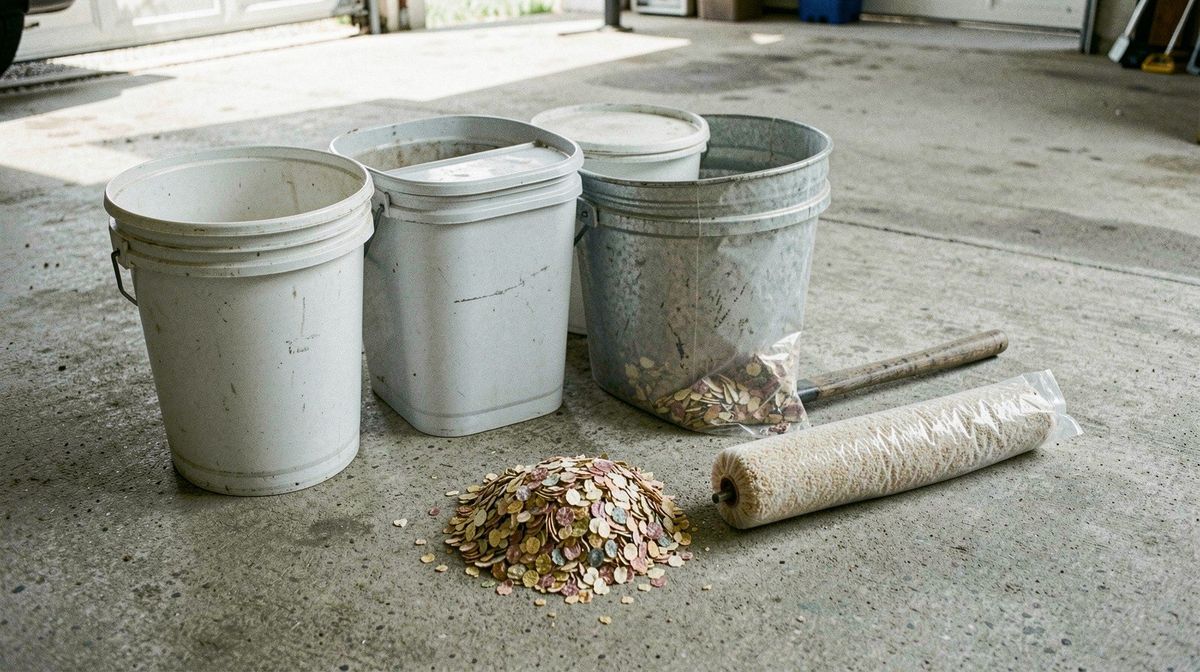
An epoxy garage floor kit bundles the products for a coating system, commonly a cleaner or etch, the epoxy resin and hardener, decorative flakes and a topcoat. Kit sizes are sold by claimed coverage, so check the data sheet for the spreading rate, the solids and VOC figures, the weather window and the safety data sheet before you buy.
Belongs to the guide: Garage Flooring Options: Coatings, Tiles and Mats
Safety note. Background reading only. Treat it as no stand-in for your owner’s manual, the maker’s install sheet, your local building and fire code, or a licensed tradesperson. A garage can hold carbon monoxide, open flame, live circuits, wound springs and solvent fumes. The Garage Notes team checked each claim against the sources listed on this page; it holds no trade licence.
A kit makes sense only if what is in the box matches your slab and conditions. This page belongs to our floors section: the floor options guide covers the choices and how to epoxy a garage floor covers the steps. We do not name or rank products.
What is in a kit?
A kit typically has a cleaner or etch, the epoxy resin and hardener, flakes and a topcoat, though contents vary. Read the contents list, then the data sheet, before you buy.
Coverage and what “2.5 car” means
Coverage is stated by the maker per unit and per coat. A “2.5 car” size is a marketing label, so measure your floor and check the data sheet. Estimate quantity with the epoxy coverage tool.
Solids content and VOC
Solids content is the share of the product left on the floor after it cures, and VOC is what evaporates as gas. EPA advises increasing ventilation when using products that emit VOCs. Compare the figures printed on the data sheet or label, since they differ by product.
Kit or separate components?
A kit is simpler, with matched parts, but you take its quantity and its system. Buying components lets you choose each layer but demands you check compatibility from the data sheets.
Kit types and which suit which garage
See the comparison table above for water-based, solvent-based, 100 percent solids and one-part products. None is ranked here. A damp slab needs fixing first; a cold garage needs a window within the temperature limits.
Checklist before you buy
- Download the data sheet and the safety data sheet; read them first.
- Check the temperature, humidity and slab limits against your garage and season.
- Confirm coverage per coat and the number of coats.
- Confirm whether primer, flakes and topcoat are included.
- Check the pot life against how fast you can work.
- Plan a moisture test: ASTM D4263 is used to indicate capillary moisture before coating.
- Plan PPE and ventilation. Uncured epoxy can be a significant skin hazard, per OSHA.
- Plan disposal: EPA says to use local hazardous waste programs and not to pour leftovers down a drain.
Common mistakes when choosing a kit
- Buying by the “car size” on the box instead of measuring the floor and reading the stated coverage per unit.
- Assuming the kit includes everything. Check whether it covers surface preparation (grinding or etching), crack filler, a topcoat, and the gloves, respirator and eye protection the data sheet calls for.
- Ignoring the working window. Note the pot life and the temperature range on the label, and plan the job so you can finish a mixed batch before it hardens.
- Skipping the moisture question. If the slab may be damp, read the data sheet’s moisture guidance first; coating a damp slab risks a coating that fails, and ASTM’s abstract says capillary moisture may be detrimental to certain coating systems.
Questions to ask the seller or maker
- Is this a true two-part epoxy, or a one-part paint sold as epoxy?
- What surface preparation does the data sheet require, and does the kit supply it?
- What temperature and humidity range is allowed during application and cure?
- How long until foot traffic and until a car can park on it, according to the data sheet?
- Where is the safety data sheet, and what ventilation and protective gear does it specify?
Related guides
| Kit type | What it is | Prep and conditions | Check on the label |
|---|---|---|---|
| Water-based epoxy | Epoxy with water as carrier | Dry, profiled slab per the data sheet | VOC, solids, temperature window |
| Solvent-based epoxy | Epoxy with a solvent carrier | Check the label for odor, fire and fume precautions | VOC, ventilation, ignition sources |
| 100 percent solids epoxy | No carrier, all product stays on floor | Check pot life and mixing ratio on the data sheet | Pot life, mixing ratio, PPE |
| One-part 'epoxy' paint | Epoxy ester or acrylic paint in a single can | Lighter duty; not a two-part epoxy | Whether it is true epoxy; recoat time |
Choose by the slab and conditions you actually have: a damp or cold slab argues for tiles or waiting, while a dry, profiled slab suits a two-part kit that you can finish within its pot life. Read the data sheet, not the front of the box.
Frequently asked questions
What is the best epoxy kit for a garage floor?
We do not rank or recommend products. Pick a kit by comparing the data sheet: coverage per coat, solids and VOC content, the application temperature window, pot life, and whether primer and topcoat are included. Your slab's moisture test and your ventilation limits matter more than the box.
How much does a 2.5 car kit cover?
The coverage is whatever the maker's data sheet states, so read it. A '2.5 car' label is a marketing size, not a standard. Measure your floor, divide by the stated coverage per coat for each coat, and add some allowance for porous concrete. Our epoxy coverage calculator helps with this arithmetic.
Are epoxy kits as good as professional coatings?
Results depend more on prep, conditions and film build than on who applies it. Kits can be a reasonable DIY route when the slab is dry and sound and you follow the data sheet. Professional systems may use different products and equipment. Compare written warranties and ask what prep is included.
Do I need a primer?
Check the data sheet. Some products require a primer, some include one, and some are applied directly. Moisture-tolerant primers may be called for on slabs that show moisture. Do not skip a required primer, and ask the maker if the sheet is unclear for your slab.
Is a one-part epoxy paint kit a real epoxy coating?
Not necessarily. One-part products are paints, such as epoxy ester or acrylic, and they do not form a two-part cured resin film. They may be fine for light use but are not the same as a two-part system. Check the label for the number of components.
Sources and further reading
- OSHA Technical Manual, Section III Chapter 1: epoxy resins and amine hardeners (osha.gov)
- EPA: Volatile Organic Compounds' Impact on Indoor Air Quality (epa.gov)
- EPA: Household Hazardous Waste (epa.gov)
- OSHA: Hazard Communication (labels and safety data sheets) (osha.gov)
- OSHA: Respiratory Protection (osha.gov)
- ASTM D4263: Indicating Moisture in Concrete by the Plastic Sheet Method (public abstract) (store.astm.org)
Related articles
- Garage Flooring Options: Coatings, Tiles and Mats
Compare garage flooring options for cold climates: coatings, tiles, mats and sealers, what concrete prep each needs, and the ventilation and safety basics.
- Epoxy Garage Floors: How They Work, Cost and Limits
How an epoxy garage floor coating system works, what prep matters, cost drivers, cold-climate limits, and the safety rules to read before you start.
- Epoxy Garage Floor Safety: Fumes, Ventilation and PPE
Safety rules for epoxy garage floor work: the SDS, skin and eye protection, fumes and ventilation, ignition sources, disposal and attached-garage cautions.
- Garage Floor Coatings: Epoxy, Polyaspartic and Paint
Compare garage floor coating types: epoxy, polyaspartic, polyurea and paint. What differs, what prep they share, and how to check moisture first.
- Garage Floor Paint: Is It Worth It, and How to Apply
When garage floor paint makes sense compared with epoxy, what types exist, how prep and moisture decide results, and the ventilation and safety basics.
- How to Epoxy a Garage Floor, Step by Step
A safety-first sequence for applying an epoxy garage floor coating: conditions, moisture test, prep, mixing, coats, cure and common mistakes.