Epoxy Garage Floor Safety: Fumes, Ventilation and PPE
Posted by MN Garage Notes Editorial Team Reviewer: MN Garage Notes Editorial Team Most recently reviewed Published In Garage floors
Epoxy garage floor work involves skin contact, fumes and flammable ingredients. OSHA's Technical Manual says skin exposure to uncured epoxy is the larger concern and that sensitization can develop, while some amine hardeners irritate the nose, throat and lungs. Read the safety data sheet, wear gloves and eye protection, ventilate, keep ignition sources away and dispose of leftovers properly.
Belongs to the guide: Garage Flooring Options: Coatings, Tiles and Mats
Safety note. Background reading only. Treat it as no stand-in for your owner’s manual, the maker’s install sheet, your local building and fire code, or a licensed tradesperson. A garage can hold carbon monoxide, open flame, live circuits, wound springs and solvent fumes. The Garage Notes team checked each claim against the sources listed on this page; it holds no trade licence.
Most epoxy floor trouble in a home garage is a safety problem first and a finish problem second. This page supports flooring options; read it before the epoxy application steps and epoxy floors. Heating the space is a separate risk: see garage heater safety and the heater comparison.
Read the SDS and the label before you start
Read the safety data sheet and the label for every product before opening it. OSHA requires safety data sheets in a specified 16-section format and labels with a signal word, pictogram and hazard statement. The SDS tells you hazards, protective equipment, first aid, firefighting, spill and disposal for that product. Where this page and the SDS differ, follow the SDS.
Skin and eye protection
OSHA’s Technical Manual says skin exposure to uncured epoxy is typically much greater than respiratory exposure, can present a significant hazard, and sensitization can develop. Wear chemical-resistant gloves of the type the SDS names, long sleeves and eye protection. Change gloves if they are contaminated. Wash with soap and water after work. If skin reacts, stop and seek medical advice.
Fumes: organic vapors, amines and respirators
OSHA’s Technical Manual says respiratory exposure to epoxies is fairly low because of their molecular weight, but inhaling some aliphatic and cycloaliphatic amine hardeners can irritate the nose and throat and cause lung irritation, and some are sensitizers. EPA lists eye, nose and throat irritation, headaches, nausea and dizziness as VOC effects. Choose respiratory protection from the SDS. OSHA’s respiratory protection page notes respirators protect against gases, vapors and dusts and links its program resources; a respirator needs the right type and fit.
Ventilation in a cold, closed garage
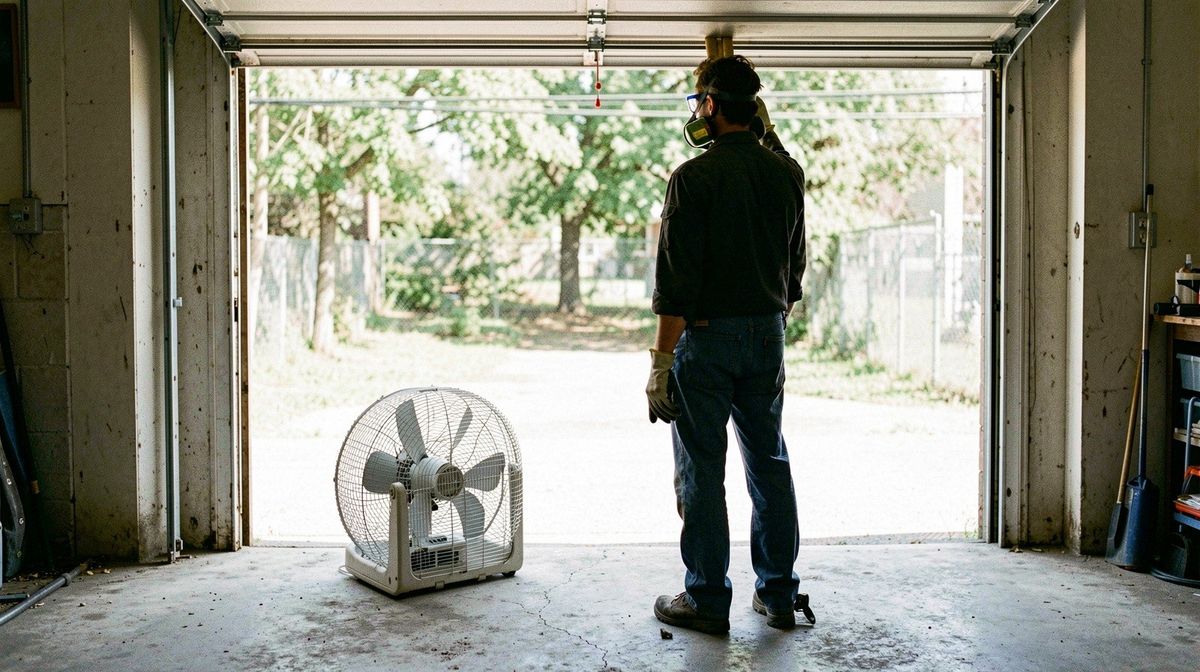
EPA advises increasing ventilation when using products that emit VOCs, and says that if a label calls for a well-ventilated area you should work outdoors or where an exhaust fan runs, or else open windows for maximum outdoor air. In practice, open the garage door, add a fan that blows out, and bring in fresh air. A cold garage tempts you to close up; do not.
- Keep the door between an attached garage and the house closed and the house’s air handler off if the SDS or label warns of vapors.
- EPA notes that automobile emissions in attached garages are a source of benzene, so limit time there.
Ignition sources and heaters
Keep sparks, pilot lights, flames and heaters out of the work area unless the label allows them. Do not run a fuel-burning heater to speed cure unless the label allows it: solvent vapors can ignite, and unvented fuel-burning heaters produce carbon monoxide. Water heaters and furnaces with pilot lights in the garage are an ignition source; turn them off only as the manufacturer’s instructions allow, or ask a licensed professional.
Cure, off-gassing and re-entry
The SDS and data sheet state cure and re-entry guidance for each product. We state no times. Keep the area ventilated, keep people and pets out until the maker says it is safe, and keep the house door closed in the meantime.
Spills, cleanup and disposal
Contain spills as the SDS directs. Keep leftover product in the original container with the label, never mix leftovers, and do not pour them down a drain or onto the ground, as EPA advises. Contact your local environmental, health or solid waste agency about household hazardous waste collection.
Pets, kids and people with asthma
Keep children and pets out of the garage and house air paths during work and cure. People with asthma, respiratory conditions or a past sensitization to epoxy or amines should avoid the work and be away from vapors; ask a doctor if unsure.
When to stop and get help
- Skin rash, blisters or breathing trouble: stop, move to fresh air, and get medical help.
- Fire or a strong chemical smell you cannot ventilate: leave and call emergency services.
- Poison questions: contact your local poison control.
Related guides
Frequently asked questions
Are epoxy fumes harmful?
They can be. EPA lists eye, nose and throat irritation, headaches, nausea and dizziness among the effects of VOC exposure, and OSHA's Technical Manual says some amine hardeners can irritate the nose, throat and lungs. Effects depend on the product and exposure. Read the SDS, ventilate heavily and leave the area if you feel unwell.
Do I need a respirator for epoxy?
Check the safety data sheet and product label, which state respiratory protection for that product. OSHA notes respirators protect against gases, vapors and dusts and that fit and type matter. If the SDS calls for a respirator, use the type it names.
Can I run a heater to help epoxy cure?
Only if the product label allows it. Solvents and some coating components are flammable, and a fuel-burning heater, pilot light or spark is an ignition source and can also produce carbon monoxide. If cold stops cure, wait for a warmer window instead of forcing it. See our heater safety guide.
How long should I ventilate after epoxy?
The product's data sheet and SDS state ventilation and return-to-occupancy guidance, and we do not invent a number. Keep fans moving and the door between an attached garage and the house closed until the maker says it is safe. Keep pets and kids out. If an odor lingers, keep ventilating.
How do I dispose of leftover epoxy?
Do not pour it down a drain. EPA says keep household chemicals in their original containers, never mix them, and contact your local environmental, health or solid waste agency about household hazardous waste collection. Follow the SDS for cured and uncured material. Do not put liquid product in regular trash unless your local program says so.
Sources and further reading
- OSHA Technical Manual, Section III Chapter 1: epoxy resins and amine hardeners (osha.gov)
- EPA: Volatile Organic Compounds' Impact on Indoor Air Quality (epa.gov)
- EPA: Household Hazardous Waste (epa.gov)
- OSHA: Hazard Communication (labels and safety data sheets) (osha.gov)
- OSHA: Respiratory Protection (osha.gov)
- ASTM D4263: Indicating Moisture in Concrete by the Plastic Sheet Method (public abstract) (store.astm.org)
Related articles
- Garage Flooring Options: Coatings, Tiles and Mats
Compare garage flooring options for cold climates: coatings, tiles, mats and sealers, what concrete prep each needs, and the ventilation and safety basics.
- Epoxy Garage Floors: How They Work, Cost and Limits
How an epoxy garage floor coating system works, what prep matters, cost drivers, cold-climate limits, and the safety rules to read before you start.
- Epoxy Garage Floor Kits: What Is in the Box and What to Check
What comes in an epoxy garage floor kit, how coverage claims work, kit types, and the data sheet and safety checks to make before you buy. No brand picks.
- Garage Floor Coatings: Epoxy, Polyaspartic and Paint
Compare garage floor coating types: epoxy, polyaspartic, polyurea and paint. What differs, what prep they share, and how to check moisture first.
- Garage Floor Paint: Is It Worth It, and How to Apply
When garage floor paint makes sense compared with epoxy, what types exist, how prep and moisture decide results, and the ventilation and safety basics.
- How to Epoxy a Garage Floor, Step by Step
A safety-first sequence for applying an epoxy garage floor coating: conditions, moisture test, prep, mixing, coats, cure and common mistakes.