Garage Door Insulation Kits: Types and What to Check
Posted by MN Garage Notes Editorial Team Reviewer: MN Garage Notes Editorial Team Most recently reviewed Published In Insulation
A garage door insulation kit is a set of foam, fiberglass or reflective panels with fasteners for the door's recessed sections. Compare R-value per inch, fire-barrier and melting-point notes, and the maker's test method, and remember R-value is not a whole-door U-factor. Kits add weight, so recheck balance and auto-reverse after installing.
Belongs to the guide: Garage Door Insulation: Options, R-Value and Cost
Kits are one of the options compared in our door insulation options; this page covers what is in them and what to check before buying.
Background reading only. Treat it as no stand-in for your owner’s manual, the maker’s install sheet, your local building and fire code, or a licensed tradesperson. A garage can hold carbon monoxide, open flame, live circuits, wound springs and solvent fumes. The Garage Notes team checked each claim against the sources listed on this page; it holds no trade licence.
Safety first: weight, balance and springs
Adding insulation to a garage door adds weight, and a door that is out of balance can strain the opener and defeat entrapment protection. DASMA says safe operation of the door, opener and entrapment protection depends on a balanced door, an effectively working opener and effectively working entrapment protection. Never adjust, loosen or replace springs, cables or brackets yourself; DASMA says those repairs and adjustments must be done by a trained door systems technician. Consult the door’s and opener’s manuals before you start.
What is in a kit
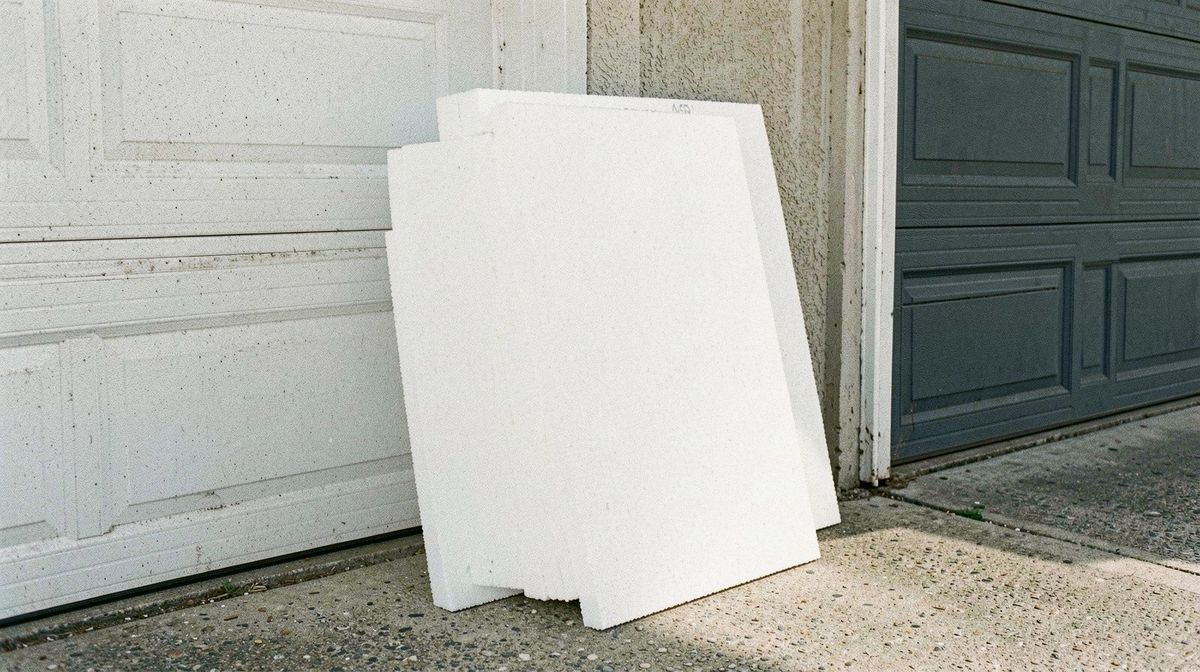
A garage door insulation kit is a set of precut panels or batts plus the retainers, tape or adhesive the maker specifies for fitting them to the door’s recessed sections. Contents vary by maker, so read the listing and manual for panel count, fasteners, facings and whether it covers your door type. This page names no brands and no products.
Panel materials
Kits use foam board, fiberglass batts or reflective foil, and the material sets the R-value per inch and the fire-safety rules. DOE’s Building America table gives approximate R-values per inch for general comparison only.
| Material | R per inch (DOE, approximate) | Safety and handling notes from DOE |
|---|---|---|
| Expanded polystyrene (EPS) | R-3 to R-4 | Requires a fire barrier; melts at 200 degrees F; not a vapor retarder |
| Extruded polystyrene (XPS) | R-5.0 | Requires a fire barrier; melts at 300 degrees F; good vapor retarder |
| Polyisocyanurate | R-5.6 to R-8 (R-7.1 to R-8.7 foil-faced) | Requires a fire barrier; R-value can decrease over time as gas escapes |
| Fiberglass batt (standard density) | R-2.9 to R-3.8 | Wear gloves, goggles and a dust mask; kraft-paper facing is flammable; batts are not an air barrier |
| Reflective foil | Not stated per inch; DOE says radiant barriers are not recommended for cold climates (attic context) | Ask for the maker’s tested R-value and test method |
R-value claims and how to check them
A kit’s R-value is a material or section figure, and DASMA says R-value is calculated for a section only and cannot be compared with a whole-door U-factor. DASMA’s worked example shows a section R-value is the sum of air films, surfaces and insulation, with insulation R equal to thickness divided by the material’s k-factor from ASTM C177 or C518 testing. Ask the maker for the thickness, material and how the R-value was determined, and be wary of a single big number with no test method. A kit does not change the door’s seals or joints, which DASMA says affect thermal performance.
Sizing for 1-car and 2-car doors
Check your door’s width, height and section recess depth, then match them to the kit’s stated coverage. See garage door sizes for common dimensions. A kit sized for one door type may not fit another. The sources opened give no standard panel count, so use the kit’s listing and manual. No source we opened gives a typical kit weight, so check the maker’s stated weight and add it to your balance test plan.
Pros, cons and who each type suits
| Type | Who it suits | Watch for |
|---|---|---|
| Foam board panels | Doors with deep recesses where you want more R per inch | Fire barrier requirement; melts at stated temperatures; keep from heaters |
| Fiberglass batt kits | Doors with shallow recesses and a dry garage | Irritation; kraft facing flammable; not an air barrier; sagging |
| Reflective foil kits | Buyers who want a thin layer | DOE says radiant barriers are not recommended for cold climates; check the claims |
Which kit is best for your door: decision by type
- Heated shop or workshop: higher R-per-inch foam plus good seals, with the heater far from the foam (see safe heater use).
- Older door in poor condition: consider a new insulated door instead.
- Door with windows: panels cover only solid sections; check the manual.
- Any door: retest balance and auto-reverse after installing, per installing door insulation.
Related pages
| Material | R per inch (DOE, approximate) | Safety and handling |
|---|---|---|
| Expanded polystyrene | R-3 to R-4 | Fire barrier; melts at 200 F |
| Extruded polystyrene | R-5.0 | Fire barrier; melts at 300 F |
| Polyisocyanurate | R-5.6 to R-8 | Fire barrier; R-value can fall over time |
| Fiberglass batt | R-2.9 to R-3.8 | Gloves, goggles, mask; kraft facing flammable |
Choose by door recess depth, how you use the garage and how the maker states R-value. Ask for the test method and weight, and keep any foam away from heaters.
Frequently asked questions
What is the best way to insulate a garage door?
No method is best for every door. Kits, cut foam and a new insulated door all suit different doors and budgets. Compare materials by R-value per inch and fire notes, seal the gaps, and recheck balance after adding weight. For a whole-door comparison, use a tested U-factor, as DASMA recommends.
Do reflective foil kits work?
Performance claims vary and no source we opened proves a foil kit's value in a cold garage. DOE's insulation table says radiant barriers are not recommended for cold climates, in the context of attics. Ask the maker for the stated R-value and how it was measured, and compare with foam or batt options.
How many panels do I need?
The number depends on the kit's panel size and your door's width, height and section count. No standard count applies. Measure your door's recessed sections, compare with the kit's stated coverage, and check the listing for 1-car or 2-car sizing. Use the garage door sizes page to confirm dimensions.
How much does a kit weigh?
Weight varies by material and kit, and no source we opened gives a standard figure. Check the maker's stated weight. Adding weight can unbalance a door, and DASMA says a balanced door is essential for safe door, opener and entrapment operation, so test that the door stays partway open after installing.
Do kits work on steel doors with windows?
Kits usually fit solid sections only, since window panels are glass or plastic. Whether a kit suits a steel door depends on its recess depth and the kit's manual. Check the kit's compatibility list, avoid drilling through the door skin unless allowed, and retest balance and auto-reverse afterward.
Sources and further reading
- U.S. DOE Building America: Energy Renovations, Insulation (PDF, 2012) (energy.gov)
- DASMA Technical Data Sheet 163: U-factor and R-value for Residential and Commercial Garage Doors (PDF) (dasma.com)
- DASMA Technical Data Sheet 167: Sectional Garage Door and Electric Operator Checklist (PDF) (dasma.com)
- DASMA: Automatic Garage Door Opener Safety and Maintenance Guide (PDF) (dasma.com)
- ENERGY STAR: DIY Checks and Inspections (energystar.gov)
Related articles
- Garage Door Insulation: Options, R-Value and Cost
Compare garage door insulation methods, R-value versus U-factor, air sealing and balance safety, with sources from DASMA, DOE and ENERGY STAR.
- Garage Insulation: What to Insulate and Which R-Value
Garage insulation explained: where heat escapes, ENERGY STAR and DOE R-values by climate zone, insulation types compared, and attached-garage safety.
- Garage Ceiling Insulation: Materials and Cold-Climate Tips
How to insulate a garage ceiling in a cold climate: target R-values from ENERGY STAR, air sealing first, light and flue clearances, and when to call a pro.
- Garage Insulation Cost: Material and Labor Factors
What decides garage insulation cost: area, R-value, material and access. Includes a fill-in worksheet, since we print no prices without a dated source.
- How to Insulate a Garage: Walls, Ceiling and Door
Step-by-step order of work to insulate a garage: seal air leaks, then walls, ceiling and door, with safety, fire-barrier and heater-clearance notes.
- How to Insulate a Garage Door, Step by Step
Step-by-step overview of insulating a garage door: balance test, panels, sealing edges and rechecking the opener, with safety limits and no spring work.