Standard Garage Door Sizes and Measuring
Posted by MN Garage Notes Editorial Team Reviewer: MN Garage Notes Editorial Team Most recently reviewed Published In Garage doors
Standard residential garage doors are commonly 8 or 9 feet wide for one car and 16 or 18 feet wide for two, in 7 or 8 foot heights. Measure width between the jambs, height at three points, and also headroom, side room and backroom, since tracks and openers need clear space. Confirm every clearance in the door maker's installation sheet.
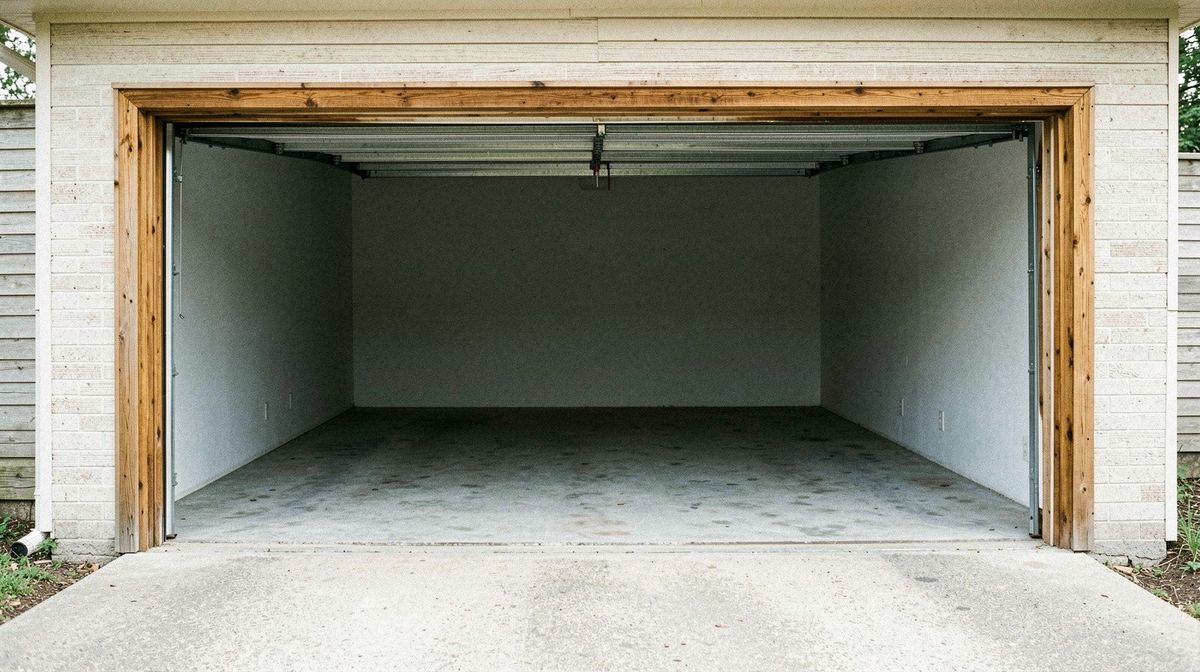
Belongs to the guide: Garage Doors: Types, Materials, Sizes and Openers
Safety note. Background reading only. Treat it as no stand-in for your owner’s manual, the maker’s install sheet, your local building and fire code, or a licensed tradesperson. A garage can hold carbon monoxide, open flame, live circuits, wound springs and solvent fumes. The Garage Notes team checked each claim against the sources listed on this page; it holds no trade licence.
Measuring a garage door opening correctly is mostly about seeing the space around the opening, not only the opening itself. This page supports our garage doors guide; it explains standard sizes and how to measure.
What are standard garage door sizes?
Standard residential doors are 8 or 9 feet wide for one car and 16 or 18 feet wide for two cars, in 7 or 8 foot heights, according to a measuring guide written by an Overhead Door distributor. We found no industry-association or manufacturer-manual source for these sizes, so treat them as common sizes, not a standard. Custom sizes are available for unusual layouts.
Common sizes in a table
The table above shows that distributor’s list. Treat it as a starting point: your door maker’s installation sheet decides what actually fits the model you choose. Specifications from retailer pages are not a reliable substitute.
How do you measure the opening?
Take every measurement with a 25-foot tape and write the numbers down.
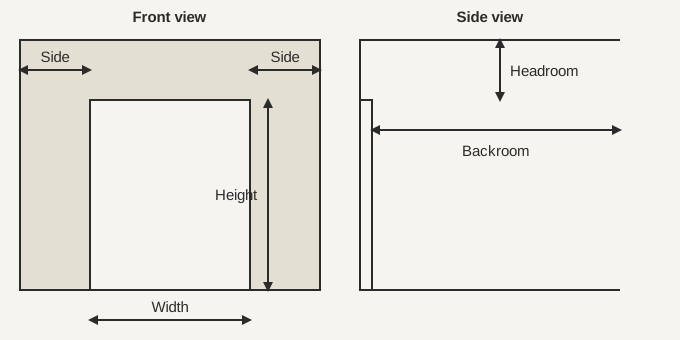
- Width: measure between the inside of the wood jambs.
- Height: measure from the floor to the underside of the header at the left, center and right. If the readings differ, the floor slopes; use the smallest.
- Headroom: measure from the top of the header to the lowest ceiling obstruction, noting lights and pipes.
- Side room: measure from each edge of the opening to the nearest side wall.
- Backroom: measure along the ceiling from the header to the rear wall.
How much headroom and side room are needed?
Headroom depends on the spring and track system (standard, low-headroom or high-lift), side room depends on the track and opener type, and backroom depends on the opener rail. DASMA notes that the track has to suit the specific door, its weight, the headroom and the opener location. We could not confirm numeric clearances from a manufacturer’s own manual, so we print none: ask the door maker for the figures for your model.
When do you need a custom size?
You need a custom size when the measured opening, headroom or side room does not match a listed size for the model you want. Low-headroom or high-lift track options can solve ceiling problems; the door maker can confirm what suits your garage.
Sizes for taller vehicles and trucks
Height is the dimension to check. Measure your tallest vehicle with any roof rack and compare it to the door’s clear opening, which can be less than the nominal height once the bottom seal and track hardware are counted. Ask the maker for the clear-opening dimension.
Safety note on hardware
Sizing a door changes the spring and cable selection. Door springs and cables are high-tension parts; DASMA says only a trained technician should adjust or replace them. Do not buy or fit springs yourself from a size guess. See door springs. Insulated options: insulated garage doors and garage door insulation.
Related guides
| Door | Typical width | Typical height |
|---|---|---|
| Single-car | 8 ft or 9 ft | 7 ft or 8 ft |
| Double-car | 16 ft or 18 ft | 7 ft or 8 ft |
| Custom | Any opening that is non-standard | Ordered to measure |
Match your measured opening to the nearest standard size only if the door maker lists it for your model; otherwise order a custom size. Never trim or force a door to fit.
Frequently asked questions
What is the standard size of a single car garage door?
One distributor's guide lists single-car doors as 8 or 9 feet wide, usually 7 or 8 feet tall. Older homes can differ, and some openings are not standard at all. Measure your own opening before you order, and check the door maker's sizing chart for the model you want instead of assuming the opening matches.
What is the standard size of a two car garage door?
The same guide lists double-car doors as 16 or 18 feet wide, in 7 or 8 foot heights. A 16 foot door is the tighter fit for two cars; an 18 foot door gives more clearance. Whether either fits depends on your header and side room, so measure the opening first.
How do I measure for a new garage door?
Measure width between the inside jambs, height from floor to the bottom of the header at the left, center and right, then headroom, side room and backroom. Use the smallest height reading if the floor slopes. Write every number down and confirm them against the door manufacturer's installation guide before ordering.
How much headroom does an opener need?
The headroom figure comes from the door's track and spring system rather than the opener alone, and we do not print a number we could not confirm from a manufacturer's manual. Ask the door maker for the headroom your model needs, and check the opener's manual for its own mounting requirement.
Do 7 ft and 8 ft doors cost differently?
Taller doors use more material and sometimes different track, so a price difference is likely, but we do not quote prices without a dated source. Ask for written quotes that list the height and width, and compare the same material, insulation construction and warranty across them.
Sources and further reading
Related articles
- Garage Doors: Types, Materials, Sizes and Openers
Plain-English guide to garage doors: door types, materials, standard sizes, openers, what to inspect, and which spring and cable jobs need a technician.
- Garage Door Remotes: Types, Compatibility and Programming
How garage door opener remotes work, how to tell which remote fits your opener, how to program one from the owner's manual, and what to do when it stops.
- Garage Door Opener Not Working: Troubleshooting
Step-by-step checks when a garage door opener will not work: power, wall button, remote, manual release and safety sensors, plus when to call a technician.
- Common Garage Door Problems and Safe Fixes
Diagnose a garage door that will not open, sits crooked, shakes or is noisy: what you can check safely, what to leave alone, and when to call a pro.
- Garage Door Springs: Torsion vs Extension and Safety
What garage door torsion and extension springs do, how to spot a worn or broken one, and why spring and cable work is for a trained technician only.