Epoxy Garage Floors: How They Work, Cost and Limits
Posted by MN Garage Notes Editorial Team Reviewer: MN Garage Notes Editorial Team Most recently reviewed Published In Garage floors
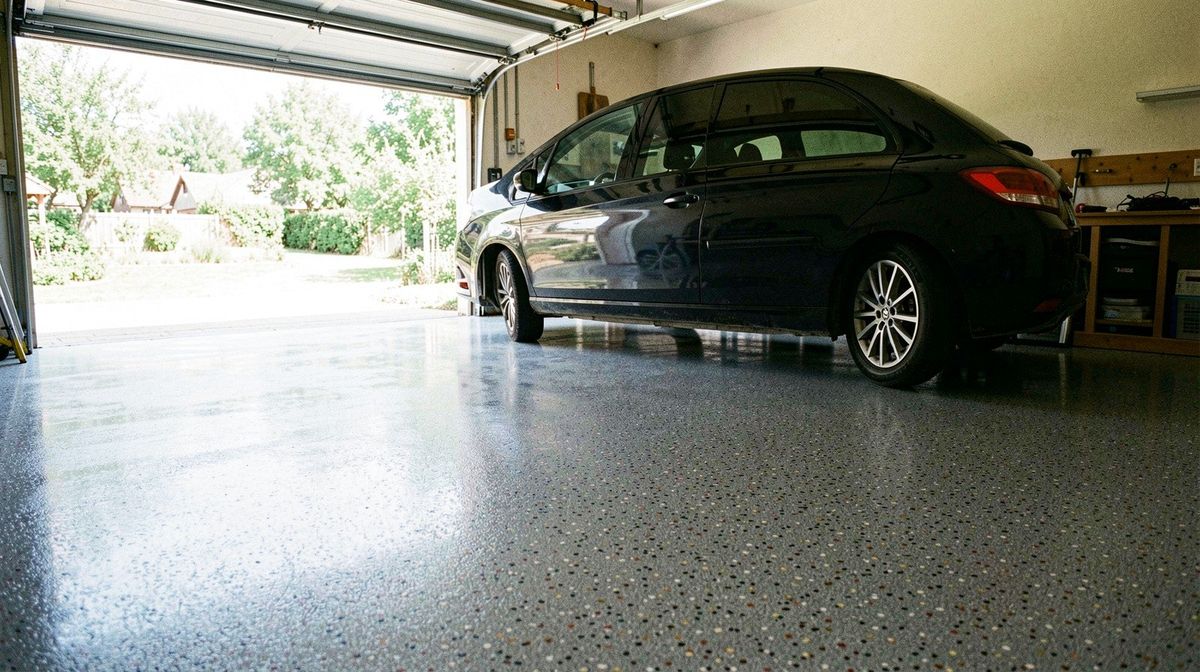
An epoxy garage floor is a coating system, usually a primer, an epoxy base coat, optional decorative flakes and a topcoat, bonded to prepared concrete. It depends on a clean, dry, profiled slab and on mixing and curing exactly as the data sheet says. Wear gloves, ventilate, and read the safety data sheet first, because uncured epoxy can sensitize skin.
Belongs to the guide: Garage Flooring Options: Coatings, Tiles and Mats
Safety note. Background reading only. Treat it as no stand-in for your owner’s manual, the maker’s install sheet, your local building and fire code, or a licensed tradesperson. A garage can hold carbon monoxide, open flame, live circuits, wound springs and solvent fumes. The Garage Notes team checked each claim against the sources listed on this page; it holds no trade licence.
Epoxy is the coating most people mean by a “garage floor coating”, and it depends heavily on prep and a dry slab. This page supports the guide to coatings, tiles and mats and covers how the system works. For steps, read the prep, mix and cure guide; for safety, read the epoxy safety basics page.
What is an epoxy garage floor system?
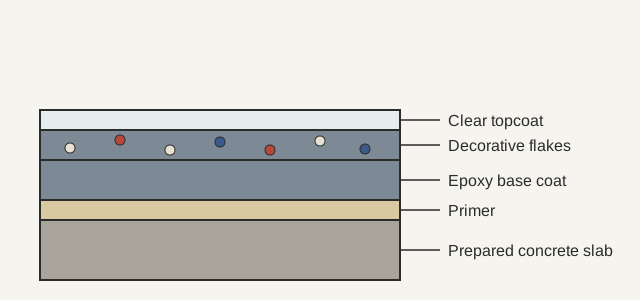
An epoxy garage floor is a coating system, usually a primer, an epoxy base coat, optional decorative flakes and a topcoat, bonded to prepared concrete. Epoxy itself is a two-part product: a resin and a hardener mixed just before use, which then cures into a hard film.
What kinds of epoxy are there?
Epoxies are sold as 100 percent solids, solvent-based and water-based products. “Solids” means the share of the product that stays on the floor after it cures; solvent and water carriers evaporate. The type affects odor, VOC content, film build and working time. Read the label and the data sheet for the numbers. A one-part “epoxy” paint is covered in painting a garage floor.
Pros and cons in a cold climate
- Pro: a continuous, easy-to-clean surface when it bonds well.
- Con: depends on a dry slab; cold slabs and condensation can cause failure.
- Check: the data sheet’s stated hot-tire and UV resistance; ask the maker if it is not listed.
- Check: slip resistance when wet; ask the maker about anti-slip options.
- Con: application windows are limited by temperature and humidity on the data sheet.
Why prep matters most
Prep is most of the job. Clean and degrease, repair cracks, profile the concrete as the data sheet directs, and test moisture. The plastic sheet method, ASTM D4263, is used to indicate capillary moisture in concrete before coating. If moisture shows, address it before coating.
What drives the cost?
Cost depends on area, system, prep and whether you hire it out. We do not quote prices without a dated source. A formula you can fill in: material = area divided by coverage per unit, times number of coats; add prep tools, PPE, flakes, topcoat and disposal. Compare quotes that list the same system and prep. Use the coverage calculator.
Safety in brief
Uncured epoxy can present a significant skin exposure hazard and sensitization can develop, per OSHA’s Technical Manual. Some amine hardeners can irritate the nose, throat and lungs. Wear chemical-resistant gloves and eye protection, ventilate, and follow the safety data sheet. Keep ignition sources away. Full detail: safe epoxy application.
Cure and recoat times
Cure, recoat and return-to-service times come from the data sheet for your product and conditions. Do not guess. Colder and damper conditions usually lengthen cure; confirm with the maker.
Maintenance and repair
Sweep, rinse off salt and clean spills. Repair chips according to the maker’s instructions, and recoat only if the data sheet describes a compatible process.
Related guides
Frequently asked questions
Is epoxy good for a garage floor?
It can be, when the slab is sound and dry, prep is done to the data sheet, and the application conditions are met. A coating is only as good as its bond to concrete. If moisture is present or prep is rushed, it may fail. Consider tiles or mats if you cannot meet the conditions.
How long does an epoxy garage floor last?
No verified lifespan exists across products, so we do not quote one. Longevity depends on prep, moisture, film thickness, topcoat and use. Read the maker's warranty terms, and keep the floor clean and free of standing salt water. Early repair of chips helps.
Does epoxy peel from hot tires?
It can, especially with poor prep or moisture. Hot-tire resistance varies by product, so check the data sheet for stated hot-tire resistance and ask the maker if it is not listed. A properly prepared slab and the system the maker specifies give the best chance.
How long before I can drive on epoxy?
The answer is in your product's data sheet, and it varies by product, temperature and humidity. Do not park until the maker says the floor is ready. Keep pets, kids and traffic off it. A cold slab usually slows cure, so allow more time than the data sheet's minimum.
Can I apply epoxy in cold weather?
Only within the data sheet's air and slab temperature limits. Cold slabs can slow cure or trap condensation. Do not use a fuel-burning heater to warm the garage unless the label allows it, because fumes and ignition sources add risk. Wait for a suitable window if you cannot meet the limits.
Are epoxy fumes dangerous in an attached garage?
Some products release VOCs, and some amine hardeners are volatile. EPA advises increasing ventilation when using products that emit VOCs, and OSHA says some amine hardeners can irritate the nose, throat and lungs. Keep the door between the garage and the house closed, ventilate, and follow the SDS. Our epoxy safety page covers respirators.
Sources and further reading
- OSHA Technical Manual, Section III Chapter 1: epoxy resins and amine hardeners (osha.gov)
- EPA: Volatile Organic Compounds' Impact on Indoor Air Quality (epa.gov)
- EPA: Household Hazardous Waste (epa.gov)
- OSHA: Hazard Communication (labels and safety data sheets) (osha.gov)
- OSHA: Respiratory Protection (osha.gov)
- ASTM D4263: Indicating Moisture in Concrete by the Plastic Sheet Method (public abstract) (store.astm.org)
Related articles
- Garage Flooring Options: Coatings, Tiles and Mats
Compare garage flooring options for cold climates: coatings, tiles, mats and sealers, what concrete prep each needs, and the ventilation and safety basics.
- Epoxy Garage Floor Kits: What Is in the Box and What to Check
What comes in an epoxy garage floor kit, how coverage claims work, kit types, and the data sheet and safety checks to make before you buy. No brand picks.
- Epoxy Garage Floor Safety: Fumes, Ventilation and PPE
Safety rules for epoxy garage floor work: the SDS, skin and eye protection, fumes and ventilation, ignition sources, disposal and attached-garage cautions.
- Garage Floor Coatings: Epoxy, Polyaspartic and Paint
Compare garage floor coating types: epoxy, polyaspartic, polyurea and paint. What differs, what prep they share, and how to check moisture first.
- Garage Floor Paint: Is It Worth It, and How to Apply
When garage floor paint makes sense compared with epoxy, what types exist, how prep and moisture decide results, and the ventilation and safety basics.
- How to Epoxy a Garage Floor, Step by Step
A safety-first sequence for applying an epoxy garage floor coating: conditions, moisture test, prep, mixing, coats, cure and common mistakes.