Natural Gas Garage Heaters: Vented Unit Heaters Explained
Posted by MN Garage Notes Editorial Team Reviewer: MN Garage Notes Editorial Team Most recently reviewed Published In Garage heating
A natural gas garage heater is typically a hanging unit heater that burns gas and needs combustion air and a vent to the outside. Installation, gas piping and venting are licensed-trade and permit work. Rules such as burner height above the garage floor come from the manual and local code, so read both before buying.
Belongs to the guide: Garage Heaters: Types, Sizing and Safety
Natural gas is the fuel in our heater comparison that most clearly calls for a licensed gas fitter, and this page explains why.
Background reading only. Treat it as no stand-in for your owner’s manual, the maker’s install sheet, your local building and fire code, or a licensed tradesperson. A garage can hold carbon monoxide, open flame, live circuits, wound springs and solvent fumes. The Garage Notes team checked each claim against the sources listed on this page; it holds no trade licence.
Safety block: carbon monoxide, gas leaks and your manual
Gas heaters are licensed-trade work: venting, combustion air, gas piping and permits are not DIY topics. Consult your owner’s manual and local fuel gas code. NFPA says all fuel-burning equipment should be vented to the outside to avoid carbon monoxide poisoning, and, if you smell gas from a gas heater, not to light the appliance, to leave the home immediately and to call the fire department or gas company. A gas unit heater manual we opened states installation and service must be performed by a licensed professional installer, service agency or the gas supplier. Details: garage heater safety.
What a gas unit heater is
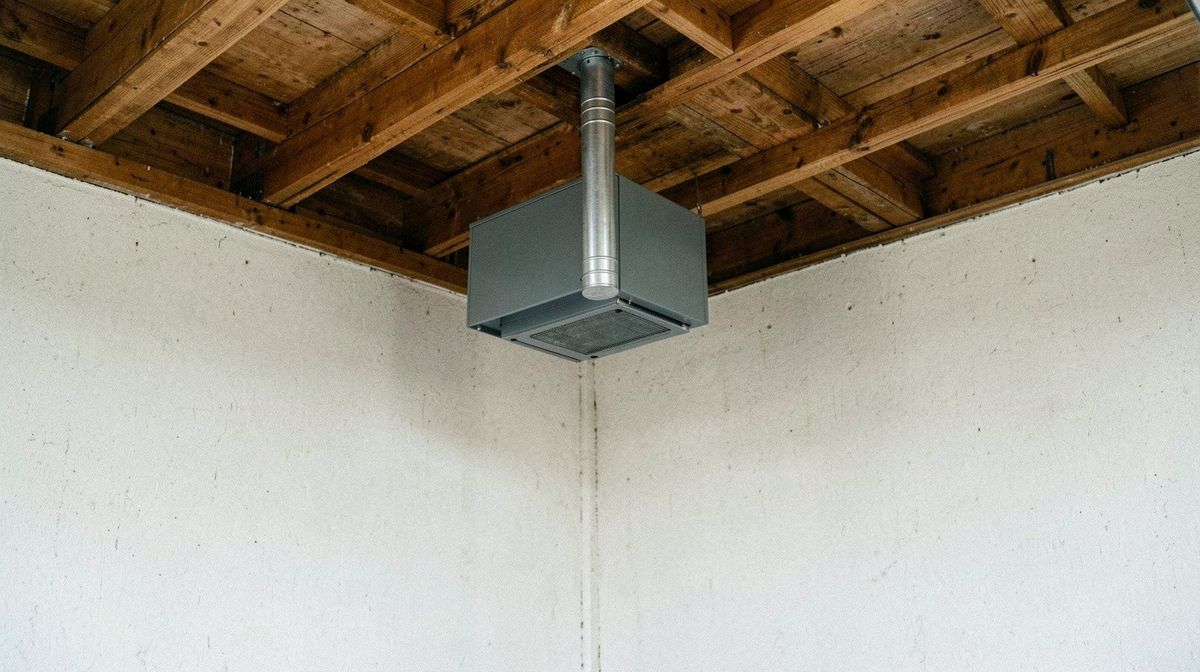
A gas unit heater is a fixed, hanging furnace-style heater that burns gas and blows heated air into a space. Designs differ in how they handle combustion. One manual we opened covers separated combustion unit heaters, in which combustion air comes in through a dedicated intake and the vent carries flue gases to the outside; it calls the vent the passageway that conveys flue gases from the appliance to the outside atmosphere. The manual also says unit heaters of that type are designed for indoor use only. Other designs have different vent and air requirements; the manual for the model governs.
Natural gas versus LP
A gas heater is built for one fuel, and switching to propane takes the manufacturer’s conversion kit. The unit heater manual we opened says its units require a separately ordered conversion kit for LP/propane gas. Never change fuel types on your own; the kit’s instructions and a licensed installer govern. Propane details and cylinder safety are on propane heaters. NFPA’s LP-gas fact sheet explains that NFPA 54 (the National Fuel Gas Code) applies inside a home after the point of delivery, with provisions for gas piping, appliance installation, safety shutoffs and venting of gas appliances.
Why venting and combustion air matter
Gas burners need air to burn cleanly, and without enough combustion air or a clear vent they can produce excessive carbon monoxide. The unit heater manual we opened requires adequate combustion and ventilation air per the national fuel gas code (ANSI Z223.1, NFPA 54) and applicable local codes, and warns that insufficient combustion air can cause headaches, nausea, dizziness or asphyxiation. It also lists chemicals (such as chlorinated waxes and cleaners and swimming pool chemicals) that contaminate combustion air and cause safety and performance problems; garages often store such products, so check your manual’s list.
Garage-specific rules: ignition source height and vehicle protection
One manufacturer’s manual requires burners and ignition source to be at least 18 inches above the floor in a residential garage, and the heater to be located or protected from vehicle damage. The same manual says its units are approved for residential garage or non-confined living space applications and gives a combustible-clearance limit: combustibles must not reach a temperature above 160 degrees F in continuous operation. These are conditions from that specific manual, not a universal rule; other models and local codes can differ. Another notice in the manual says not to install a unit heater near fire sprinklers because normal operating temperatures could activate them.
Sizing and efficiency
Size the heater to the garage heat load, not to the biggest unit available. DOE’s home heating guide says proper sizing is as important as efficiency and that oversized heating systems cost more to operate. Efficiency ratings are in the manual. Get the heat load from the heater sizing tool after insulating the garage. This page quotes no sizing figure because none fits every garage.
Gas line and installation: licensed trades and permits
A gas line extension, gas appliance hookup and flue installation need a licensed gas fitter and usually a permit. NFPA says to have a qualified professional install stationary space heating equipment according to local codes and the manufacturer’s instructions. This site gives no gas-line or vent-assembly steps. Ask your local building department which permits apply and who must inspect.
Annual inspection and CO alarms
Have fuel-burning heating equipment cleaned and inspected every year by a qualified professional, and keep working CO alarms. NFPA and USFA advise annual professional cleaning and inspection of heating equipment, and the CDC says gas, oil or coal burning appliances should be serviced by a qualified technician every year. The CPSC also advises CO alarms on every level and outside sleeping areas, battery-operated or with battery backup, tested monthly. Minnesota Statute 299F.51 requires an alarm within 10 feet of each room used for sleeping in a single-family home. Check the heater and alarm manuals for garage guidance.
Related pages
Frequently asked questions
Can I install a gas heater in my garage?
Only a licensed professional should install it, and only a model whose manual allows garage use. One unit heater manual we opened requires installation and service by a licensed installer, service agency or the gas supplier. Local codes and permits apply, so ask your building department before buying equipment.
Do gas garage heaters need to be vented?
Vented types do, and NFPA says all fuel-burning equipment should be vented to the outside to avoid carbon monoxide poisoning. Venting and combustion air requirements come from the model's manual and the national fuel gas code. Do not modify a vent or combustion air connection, and never run a unit with a blocked vent.
Does a gas heater in a garage need to be raised off the floor?
One manufacturer's manual requires burners and ignition source at least 18 inches above the floor in a residential garage, with protection from vehicle damage. That is a product-specific requirement, not a universal rule, so check your model's manual and local code.
How much does a natural gas heater cost to run?
Multiply the gas the heater burns per hour by your utility's price per unit of gas, using the heater's input rating and efficiency from its manual. This page quotes no price because no dated primary price source was opened. Insulation and thermostat settings often change the total more than the heater model.
Can I convert a natural gas heater to propane?
Only if the manufacturer offers a conversion kit for that exact model; the unit heater manual we opened says a separately ordered kit is required for LP/propane gas. Follow the kit's instructions and use a licensed installer. Never drill, swap or adjust gas parts yourself, and have the work checked for leaks and combustion safety.
Sources and further reading
- NFPA: Heating Safety tip sheet (PDF) (nfpa.org)
- NFPA: Liquefied Petroleum Gas fact sheet (PDF) (nfpa.org)
- Example manufacturer manual: separated-combustion unit heater installation instructions, 508065-01 (PDF) (lennox.com)
- CPSC: Carbon Monoxide Information Center (cpsc.gov)
- CPSC: Keep Warm and Safe This Winter (2026 release) (cpsc.gov)
- USFA: Heating Fire Safety (usfa.fema.gov)
- U.S. Department of Energy: Home Heating guide (PDF) (energy.gov)
- Minnesota Statutes 299F.51: Requirements for carbon monoxide alarms (revisor.mn.gov)
Related articles
- Garage Heaters: Types, Sizing and Safety
Compare electric, natural gas and propane garage heaters by venting, carbon monoxide risk, clearances and who must install them, with sources cited.
- Electric Garage Heaters: 120V vs 240V, Wattage, Circuit
How electric garage heaters work, how to convert watts to BTU, what 120V and 240V mean for circuits, and the clearance and cord rules from NFPA.
- Garage Heater Safety: CO, Clearances and Fire Risk
Garage heater safety explained from CPSC, CDC, NFPA and USFA sources: carbon monoxide, clearances, flammable vapors, alarms and what never to do.
- How to Heat a Garage: Options, Sizing and Cost Factors
How to heat a garage in order: insulate and seal, find the heat load, pick a heater type, and follow the carbon monoxide and clearance rules.
- Infrared and Radiant Garage Heaters Explained
Infrared and radiant garage heaters explained: electric versus gas-fired types, 3-foot clearances, manual mounting rules and fire safety near vapors.
- Propane Garage Heaters: Safety, Venting and Sizing
Propane garage heater safety, venting and sizing basics from CPSC, NFPA and DOE: vented versus unvented units, CO risk, cylinders and who should install.