Garage Door Opener Not Working: Troubleshooting
Posted by MN Garage Notes Editorial Team Reviewer: MN Garage Notes Editorial Team Most recently reviewed Published In Garage doors
When a garage door opener will not work, check power, the wall button and remote, the door lock setting, and the safety sensors, in that order. If the motor runs but the door does not move, the door may be disconnected from the trolley. Never bypass photo eyes or the reverse feature, and stop if a spring or cable looks damaged.
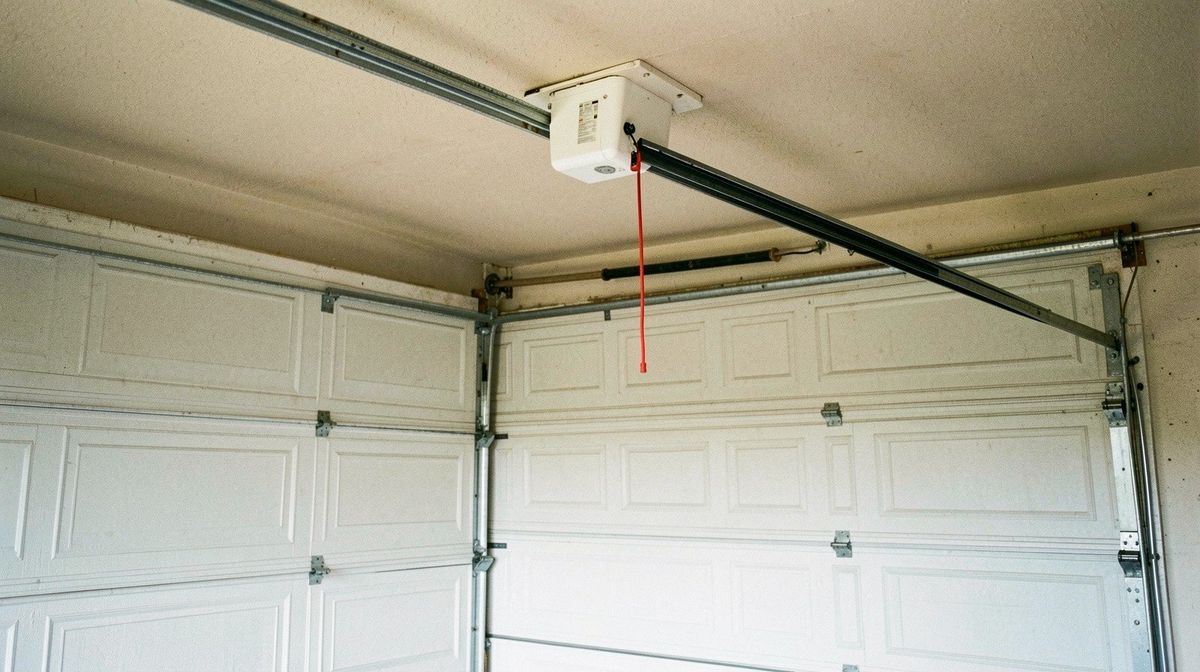
Belongs to the guide: Garage Doors: Types, Materials, Sizes and Openers
Safety note. Background reading only. Treat it as no stand-in for your owner’s manual, the maker’s install sheet, your local building and fire code, or a licensed tradesperson. A garage can hold carbon monoxide, open flame, live circuits, wound springs and solvent fumes. The Garage Notes team checked each claim against the sources listed on this page; it holds no trade licence.
Most opener complaints come down to power, a disconnected door, a blocked sensor or a door that is too heavy to lift. This guide is a triage path within our garage doors guide; it covers checks a homeowner can do safely, and it stops where spring work starts. For remotes, see garage door remotes.
Safety first: what never to bypass
Do not disable or bypass the photo eyes or the auto-reverse feature. CPSC says openers made or imported for sale in the US after January 1, 1991 must reverse, and an external entrapment system has been required since 1993. The standard is 16 CFR Part 1211, which incorporates UL 325 by reference. Also see spring types and safety before touching any hardware.
Start here: power, wall button, remote and lock
Run these in order.
- Is the opener plugged in and the outlet live? Check the breaker and any GFCI outlet.
- Is the wall control showing power or lit? Press it.
- If the wall button works but the remote does not, go to the remote page.
- Check that the wall control’s lock or vacation setting, if any, is off.
- Check the door’s own lock, if it has one, and any deadbolt.
The opener runs but the door does not move
The door is probably disconnected, or something is stopping it.
- Pull the release and move the door by hand. If it lifts smoothly and stays when left partway open, it is balanced, and you can reconnect it per the manual.
- If it is very heavy or drops, stop. A spring or cable may be broken: see why springs are a pro job.
- Check the track for obstructions or ice, but do not loosen hardware.
The door reverses or will not close
Reversing usually means the opener thinks something is in the way.
- Clear the door’s path.
- Wipe each photo eye lens and check that both indicator lights are steady.
- Check the eyes are aimed at each other and mounted no higher than 6 inches above the floor, as DASMA advises.
- Test the door again, and run the 2x4 test: lay a 2x4 flat on the floor in the door’s path. If the door does not reverse on contact, disengage the opener until it is adjusted per the owner’s manual, repaired or replaced.
Hum, click or no response: motor and logic board symptoms
If the opener hums, clicks, or does nothing with power present, the cause may be inside the unit, such as a capacitor, gear or logic board. Opening the housing exposes electrical parts; follow the manual and leave internal repair to a qualified technician. We do not give internal repair steps.
Cold-weather problems
Cold can stiffen lubricant, rollers and seals, and the bottom seal can freeze to the floor.
- Clear snow or ice from the sill and the seal.
- Check the door moves freely by hand when disconnected.
- Follow the door maker’s lubrication guidance. DASMA says springs can squeak from normal use and suggests a spray-on lubricant made for garage doors before calling a technician; if the noise continues, call a professional installer.
- A tight door may also need hardware adjustment: ask a technician.
Force and travel limit adjustments
Force and travel limits are set per the owner’s manual, and changes affect reversal behavior. DASMA recommends having a trained door systems technician handle sensitivity adjustments if the door does not reverse readily. Retest with the 2x4 after any change.
What is safe to do yourself and when to stop
Safe: checking power, cleaning and aiming sensors, clearing the track, disconnecting the door per the manual and testing balance. Stop and call a trained technician for: a door that is heavy or falls, any spring, cable or bracket problem, a door that will not reverse, a burning smell, or any internal electrical fault. Ask the technician to explain the finding in writing.
Related guides
Frequently asked questions
Why does my garage door opener hum but not open?
A hum with no movement can mean the door is still disconnected from the opener, the door is binding, or a spring is broken, which makes the door too heavy. Check the release first. Do not repeatedly run the motor against a heavy door, and do not lift it if a spring or cable looks damaged. Call a trained technician.
Why does my garage door open then close again?
If the door reverses on closing, the opener may be sensing an obstruction: misaligned or dirty photo eyes, something in the path, or a force or limit setting. Clear the path, wipe and realign the sensors per the manual, and retest. Do not disable the reverse feature; ask a technician if it persists.
Why does my opener work in summer but not in cold weather?
Cold can thicken grease, stiffen seals and rollers, and make a door heavier to move, which can trip the opener's force limit. The cause may also be a door frozen to the floor. Clear ice, check the door moves freely by hand, and follow the manual for any force adjustment.
How do I open the garage door manually?
Close the door if you can, pull the opener's quick-release cord or handle to disconnect the door, then lift using the handle or gripping point. Never put fingers between sections. If the door is hard to lift or will not stay put, a spring may be broken: do not force it and call a trained technician.
How long do garage door openers last?
The sources we opened give no lifespan, so we do not state one. Use the opener manual and warranty. Check that the opener meets the federal reversing and entrapment requirements; very old openers without external sensors or reverse should be repaired or replaced, as CPSC advises.
Should I repair or replace an opener?
CPSC advises replacing an opener that does not reverse, and says to disengage one that fails the 2x4 test until it is adjusted per the manual, repaired or replaced. For other faults, compare the repair quote with the cost of a new unit and the door's condition, since a worn door can stress a new motor. Ask a technician which is cheaper.
Sources and further reading
- CPSC: Non-Reversing Automatic Garage Door Openers Are a Hazard (Pub. 523) (cpsc.gov)
- DASMA: Garage Door Safety Tips (dasma.com)
- DASMA: Garage Door Opener Safety Tips (dasma.com)
- DASMA: Garage Door Systems Safety Tips (dasma.com)
- 16 CFR Part 1211: Safety Standard for Automatic Residential Garage Door Operators (Cornell LII) (law.cornell.edu)
- 16 CFR Part 1211 on eCFR: effective date and incorporated standards (ecfr.gov)
Related articles
- Garage Doors: Types, Materials, Sizes and Openers
Plain-English guide to garage doors: door types, materials, standard sizes, openers, what to inspect, and which spring and cable jobs need a technician.
- Garage Door Remotes: Types, Compatibility and Programming
How garage door opener remotes work, how to tell which remote fits your opener, how to program one from the owner's manual, and what to do when it stops.
- Common Garage Door Problems and Safe Fixes
Diagnose a garage door that will not open, sits crooked, shakes or is noisy: what you can check safely, what to leave alone, and when to call a pro.
- Standard Garage Door Sizes and Measuring
Standard single and double garage door widths and heights, how to measure width, height, headroom and side room, and when you need a custom size.
- Garage Door Springs: Torsion vs Extension and Safety
What garage door torsion and extension springs do, how to spot a worn or broken one, and why spring and cable work is for a trained technician only.